How Kahn Scolnick and the Federalist Society Profited from LA’s Homelessness Fraud
Kahn Scolnick — Federalist Society member and named partner at Gibson Dunn Crutcher — defended Los Angeles in federal court over its homelessness fraud while simultaneously working as Board President of the Legal Aid Foundation of Los Angeles, the nonprofit collecting those same dollars. Behind this conflict of interest stands the hidden hand of the Federalist Society and international finance.
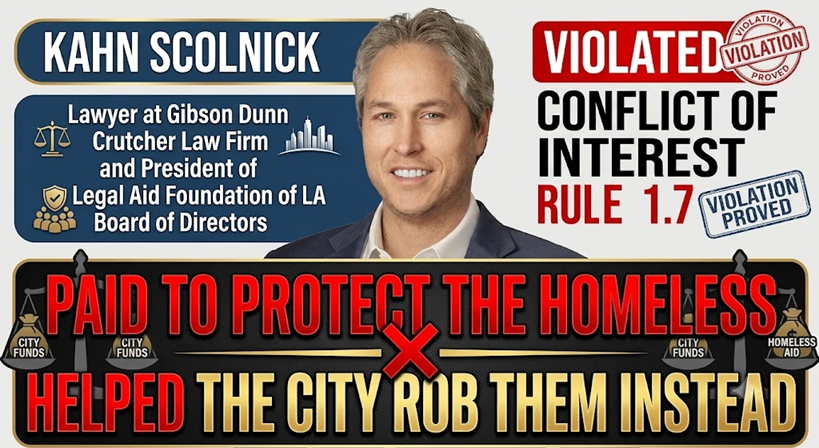
Kahn Abrahm Scolnick license number 228686 is a licensed California lawyer and named partner at the Gibson Dunn Crutcher law firm. He has a brother named Chase Scolnick who also works as a California lawyer at the firm of Keller Anderle Scolnick.
INTRODUCTION
There's a lawyer in Los Angeles named Kahn Abrahm Scolnick, license number #228686. You've probably never heard of him. By the end of this article, you won't forget him.
Kahn Scolnick is a partner at Gibson, Dunn & Crutcher, a powerful multinational law firm with clients ranging from large corporations to foreign governments. For the past several years, Kahn Scolnick’s resume shows he has held two jobs at the same time, ranging from at least 2022 until now. On one letterhead, he was the lead defense lawyer for the City of Los Angeles in the landmark federal lawsuit over the City's handling of homelessness money - known as Los Angeles Alliance for Human Rights vs City of Los Angeles Case Number 2:20-cv-02291 - a case the City fought for six years and lost. On the other letterhead, he was President of the Board of Directors of the Legal Aid Foundation of Los Angeles (LAFLA), the non-profit organization whose entire mission is serving the low-income and unhoused Angelenos that same taxpayer money was supposed to help — an organization that itself holds millions of dollars in City contracts, and that the City's own elected City Attorney publicly accused of dodging financial oversight as recent as June 2026.
Defending the City's handling of homelessness funds with one hand, presiding over the homeless-serving legal aid empire with the other. Proof of Kahn’s years long blatant violation of the California State Bar Rule 1.7 Conflict of Interest clause comes from LAFLA's own annual reports, the federal court's own docket, and the City Attorney's own press releases.
Here's the thing, though: Kahn Scolnick isn't the story. He's the keyhole. Look through him and you can see the whole machine.
Because the real question isn't how one lawyer ended up on both sides of the ledger. The real question is why nobody in the system publicly questioned and stopped him from achieving such an egregious level of self-dealing and unjustifiable violation of every conflict-of-interest due process check.
Nobody did. Not his firm. Not LAFLA's board. Not the elected City Attorney whose office vets and supervises every outside lawyer the City hires — a career banking attorney who spent decades at the top of corporate finance before taking over the City's legal machinery. The arrangement sat in plain sight, in annual reports and court filings, for years. A system where that's normal is a system custom-built for the express purpose of creating and upholding corruption. And once you see this naked truth, you understand why Los Angeles could take in billions of dollars for homelessness — bond money, your money, borrowed in your name and repaid with your property taxes for decades — while homeless people died on the sidewalk at a rate roughly approaching a dozen per day and a federal judge who found the City couldn't even prove its own numbers were real.
To be clear, just because the self-evident conflict of interest was never discussed publicly by the Los Angeles City government, the law firm of Gibson Dunn Crutcher, or LAFLA does not mean that these agencies/individuals were clueless about the conflict. The evidence overwhelmingly shows that all parties knew of Kahn's conflict yet did nothing about it.
To get a complete understanding and appreciation for what is going on here, we need to see through the looking glass while simultaneously zoomed in on the micro details and zoomed out on the macro. Zoom in, and you only see one lawyer, one contract, one courtroom. Zoom out, and you get the financial instrument quietly running underneath all of it: government bonds, a mechanism that dictates sovereignty, collects its fees up front, defers its accountability for decades, and gets bought and sold in a global market by people who will never walk down Fifth and San Pedro or care what happens there either. Neither lens tells the full truth alone. A story about one lawyer violating California State Bar Rule 1.7 is just a bar complaint. Zoom out and you see the complete story - global finance, foreign policy and how they make their way into your backyard.
Put them together and you get what actually happened in Los Angeles, the United States, and the whole world.
Table of Contents
Here are the stops along our journey:
First, the case the City lost. LA Alliance v. City of Los Angeles — what the federal court actually found, in plain language: the broken commitments, the numbers the City couldn't back up, the Mayor and Council President dragged into contempt proceedings, the $7.5 million of taxpayer dollars the City paid Gibson Dunn law firm to fight its own lack of accountability, and the endgame: an independent monitor named Nardello & Co led by Amie Chang with a national-security-grade resume, the same investigations firm that untangled FTX.
Second, the warnings nobody heeded. Fifteen years before this case, homeless veterans sued over 388 acres in West LA deeded to house disabled soldiers — which was abused by being leased out to a private school to build a sports complex, UCLA's baseball stadium, a hotel laundry, and an oil operation, with the rental money unaccounted for. The case, Gregory Valentini vs Eric Shinseki Case Number 2:11-cv-04846, whereby a federal judge voided the leases and ordered the Veterans Affairs hospital to do what its mission statement says – provide quality care to veterans.
Third, the gatekeeper. Every outside law firm the City hires, every contract the City signs, runs through one elected office: the City Attorney. We'll look at who has been sitting in that chair, what her career trained her to see and ignore, and the remarkable moment in June 2026 when her own office publicly turned on LAFLA — revealing that a $7 million taxpayer funded 'pilot' project contract had been amended nine times into more than $90 million without the basic audit reporting the original contract required.
Fourth, the lawyer at the center. The full Kahn Scolnick (or as I call him “Conflict Kahn”) record, dated and documented: the board presidencies, the courtroom appearances, the State Bar complaint and what happened to it, the conflict-of-interest policy his own organization says its officers sign every year — and the surprising second Scolnick sibling who shows up on the criminal-defense side of the same homelessness fraud scandal.
Fifth, the machine that pays for it all. How government bonds actually work, who gets paid the day the money is borrowed, who's still paying it off twenty years later, and why this structure — fees now, accountability never — is practically engineered for what happened here. Los Angeles' own audits supply the numbers: a $1.2 billion bond measure, a promise of 10,000 housing units, and apartments that ended up costing as much as $837,000 apiece on the low end – over 10x their projected cost.
Sixth, the ideas factory. The professional network that trains and credentials the people who run this machine — the Federalist Society, the Heritage Foundation, the house journals like Foreign Affairs Magazine where the governing class talks to itself — and the documented ethics record of the network's most celebrated member, Clarence Thomas, sitting on the Supreme Court. Kahn Scolnick himself published in the Federalist Society's own newsletter back in 2008.
Finally, what the record demands: proactive, peaceful, lawful, organized resistance against a universal theme since time immemorial – tyranny and despotism. Reading and being informed is only 20% of the battle. To win the war, you must have the resilient psychological constitution and political willpower to go the mile. Understanding how these structures impact us all even before we are born all the way through the time we die (see pre-birth to prison pipeline), filing complaints, building a public counternarrative with a cohesive public record, lawsuits, and protests.
| Who/What | Why They Matter |
|---|---|
| Kahn Scolnick | Gibson Dunn partner; lead defense counsel for the City in the LA Alliance case; simultaneously Board President of LAFLA, 2022 to present. |
| Gibson Dunn & Crutcher Law Firm | Global law firm paid roughly $7.5 million to defend the City; also filed the City's motion to attempt to remove Judge Carter from the LA Alliance case. |
| Legal Aid Foundation of Los Angeles (LAFLA) | Nonprofit organization providing legal services for low-income and unhoused Angelenos; holder of $90M+ in City contracts; publicly accused by the City Attorney of resisting oversight. |
| Los Angeles Alliance vs City of Los Angeles | The federal lawsuit (2020–2026) over the City's homelessness commitments. The City lost, dropped its appeal, and accepted an independent monitor. |
| Judge David Carter | The federal judge who found the City in breach, refused to seize control of the City, and chose a more dangerous remedy: a permanent public record. |
| Hydee Feldstein Soto | Elected L.A. City Attorney (2022–2026); career corporate-finance and banking lawyer; every outside counsel engagement runs through her office. Voters denied her a second term in June 2026. She also defended a Scientologist child predator named Anthony D'Amato in Case Number 24CJCM07073-01 by entering an illegal secret plea deal without consulting the victims beforehand, just like the case of Jeffrey Epstein. |
| Homeless Veterans Cases | Valentini v. Shinseki (2011) and Powers v. McDonough (2022): homeless veterans sued over 388 acres deeded to house disabled soldiers and leased to private users instead. The homeless veterans won. |
| Proposition HHH | The $1.2 billion homeless-housing bond L.A. voters approved in 2016. Promised ~10,000 units; produced units costing roughly $1 million each. |
| Nardello & Co. | The private investigations firm whose Los Angeles Office is led by Managing Director Amie Chang — staffed with national-security veterans, forged on the FTX fraud — now auditing the City's homelessness numbers as court monitor. |
| Chase Scolnick | Kahn's brother; name partner at Keller Anderle Scolnick; lead defense lawyer for defendant Alexander Soofer in State felony case number 26CJCF00450, one of the first individuals criminally charged with stealing homelessness funds. |
| The California State Bar Complaint Against Kahn Scolnick | Filed January 2026 over Scolnick's dual roles under conflict-of-interest Rule 1.7 for being the President of the Board of LAFLA and lead lawyer for City of LA in the Alliance case; pending review with the California State Bar's Complaint Review Unit. |
| Oceanwide Plaza ("Graffiti Towers") | A $1.2 billion, three-tower downtown complex, substantially built and then abandoned in 2019 when Chinese capital controls cut off its funding. Empty for seven years beside the Convention Center; sold out of bankruptcy in 2026 for $470 million. |
Chapter 1: The Case the City of Los Angeles Lost - LA Alliance vs City of LA
All right. Zoom in. We start in a federal courtroom, with a judge who has run out of patience.
In March 2020, a group of downtown residents, business owners, and service providers calling itself the LA Alliance for Human Rights sued the City of Los Angeles in federal court. Their claim, stripped of legal packaging, was simple: Los Angeles was taking in enormous sums of taxpayer funded money to address homelessness, the crisis was getting worse anyway, and the gap between the taxpayer money and the results was itself a legal injury to the people living in the middle of it. The case was assigned to Judge David O. Carter of the Central District of California, a decision previously reported as having occurred because its other sitting Judges all had conflicts of interests due to their current or past involvement with the City and its many associated businesses.
It's important to note that the Plaintiff, LA Alliance, consists of a consortium of wealthy downtown Los Angeles commercial real estate owners whose primary interests were their personal grievances of plummeting property value due to vandalism by the homeless. In other words, they do not represent the interests of the homeless and do not care about the homeless but rather used the homelessness crisis as an attack vector to prosecute the City government. The same goes for the numerous intervenors mentioned in the introduction, most of whom have never once stepped foot in the courtroom to plead for the homeless but rather their income is directly tied to budget pools under the guise of providing services to aid the homeless. It is a clinically cold but crucial note, which speaks directly to the complexity and nuance that is in this greater story that we unravel in this article.
The 2020 Settlement Agreement and Memorandum of Understanding
The early years produced one false start and one binding commitment. In 2021, Judge Carter issued a sweeping preliminary injunction; the Ninth Circuit reversed it on standing grounds later that year. Then, in 2022, rather than face trial, the City settled. The settlement was not vague: the City agreed to create 12,915 new beds and housing opportunities for unhoused residents, on a schedule, with reporting obligations, and the court retained jurisdiction to enforce it. The County entered parallel commitments. From that point forward, the question in the case was no longer whether the City had legal duties. The City had written its own duties down and signed them. The question was whether it would keep its word and prove it with real numbers.
The May 2025 Trial and June 2025 Court Order
Three years later the answer arrived. In May and June 2025, Judge Carter held evidentiary hearings on whether the City was complying with the agreement. The plaintiffs asked Judge Carter to take the extraordinary step of putting the City’s homelessness programs into receivership — to strip the elected government of control and hand it to a court-appointed officer.
In late June 2025, Carter issued his order. He found the City in breach of its settlement obligations on four separate grounds, centered on a fact that should stop any taxpayer cold: the City could not produce reliable data proving what its money had bought. Beds were counted that could not be verified. Milestones were reported that could not be reconciled with the underlying records. The court had been given numbers that did not hold up when checked.
And yet Carter denied receivership. His remedy was different, and in the long run harder for the City to escape: continued federal supervision, quarterly public status hearings, and independent verification of every number the City reports. Instead of taking the government over, he ordered it to prove itself in public.
How The City Chose To Fight
A defendant’s litigation choices are a public record of its priorities, and every one of these choices were made by lawyers the City paid with taxpayer money. Our money to fight their corruption.
The City contested the plaintiffs’ attorneys’ fees; on January 6, 2026, the court awarded roughly $1.8 million, and the City appealed even that. The City’s outside counsel, Gibson Dunn, filed a motion seeking to disqualify Judge Carter — the judge who had just spent five years learning the record — from continuing to preside. It did not succeed. The City appealed the merits to the Ninth Circuit, briefed it, and then, in May 2026, with oral argument approaching, abandoned the appeal, which the City knew had no merits. The settlement’s obligations stand: construction obligations running through 2029, a commitment that 19,600 people be housed by June 2027, the 12,915 beds, and — the detail this article will return to in Section 5 — an outside monitor, Nardello & Co., led by Amie Chang and retained at $150,000 a year to verify the City’s numbers because the court would no longer take them on faith.
During the same period, contempt proceedings reached the top of City government, naming Mayor Karen Bass and Council President Marqueece Harris-Dawson in direct connection with the City’s failures to comply with the court’s requirements.
For this defense, the City paid Gibson Dunn approximately $7.5 million using taxpayer dollars. Total it honestly: the City spent millions of taxpayer dollars fighting the referee — the fee award, the judge, the appeal — and in the end kept every obligation it had been fighting, plus a monitor. A city that litigates harder against oversight than it works against the crisis has told you, in its own filings, what it actually prioritizes.

Amie Chang
Amie Chang is the Managing Director and Head of the Los Angeles and San Francisco Offices of the private investigative firm known as Nardello & Co.
She currently leads the Nardello team auditing the City of LA’s accounting regarding homelessness to ensure compliance with its June 2026 compliance terms.
Amie’s resume is complete with national security expertise and international finance experience.
The Criminal Cases Currently Being Prosecuted Over Homelessness Accounting Fraud
Here the story forks, and the fork matters. Everything above is civil: breach of settlement, failures of data and delivery. The June 2025 order is not a fraud verdict, and this article will not pretend otherwise. The fraud allegations have their own track — the criminal courts — and that track is now live.
Beginning in the months after the civil case ended, state and federal prosecutors began charging individuals with stealing the taxpayer money from homelessness programs outright. Among the first: Alexander Soofer, Cody Holmes, and Steven Taylor, charged in cases announced by the Los Angeles County District Attorney and the U.S. Attorney for the Central District of California.
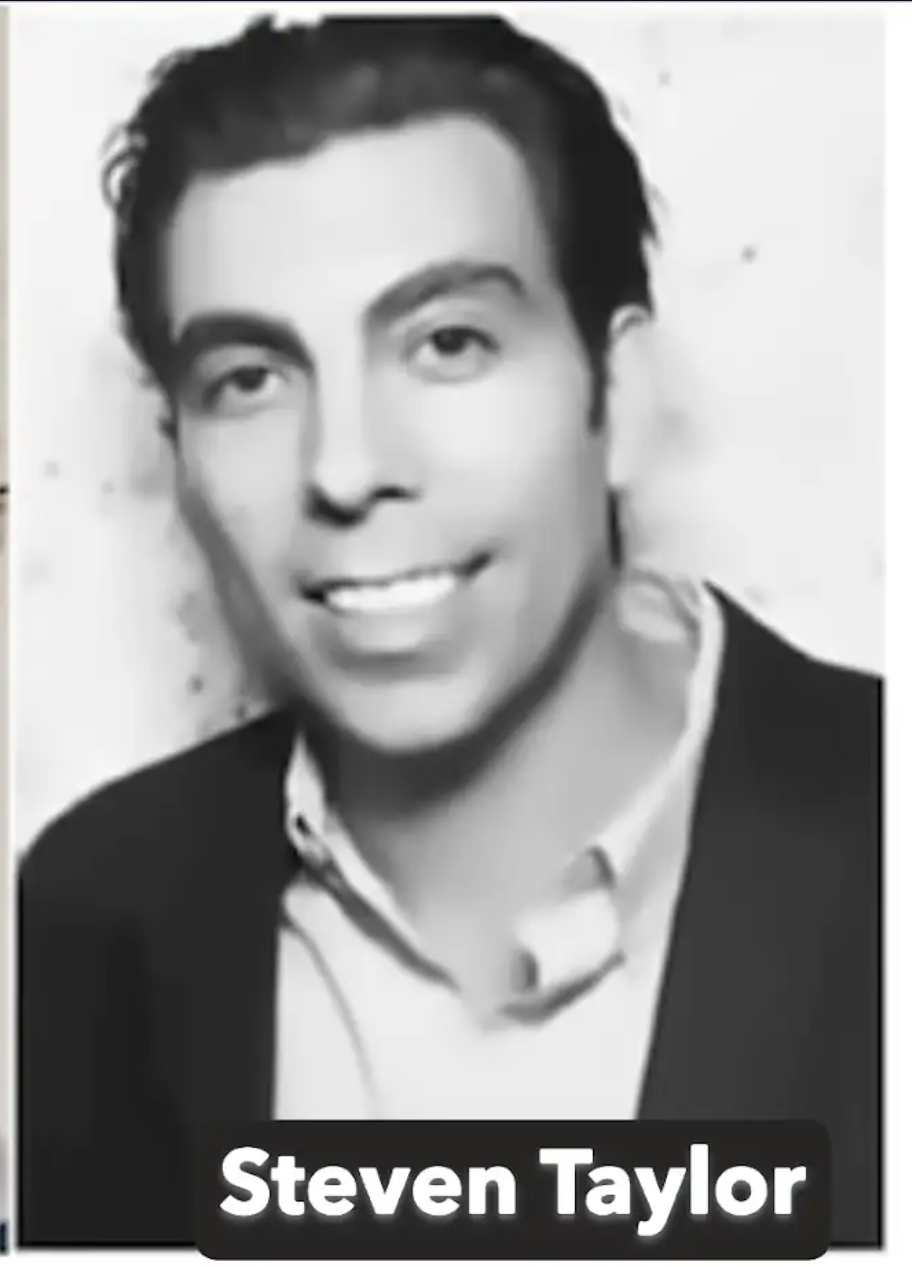
Steven Taylor
Defendant Steven Taylor was prosecuted in connection to real estate fraud in part due to ties to homelessness financial fraud. He faces several felony charges and his case United States v. Steven Taylor Case Number 2:25-cr-00736 can be found on CourtListener.
The Central District of California also published the following press release on his prosecution.
If the press release link does not work, you can also view it as a PDF by clicking here.
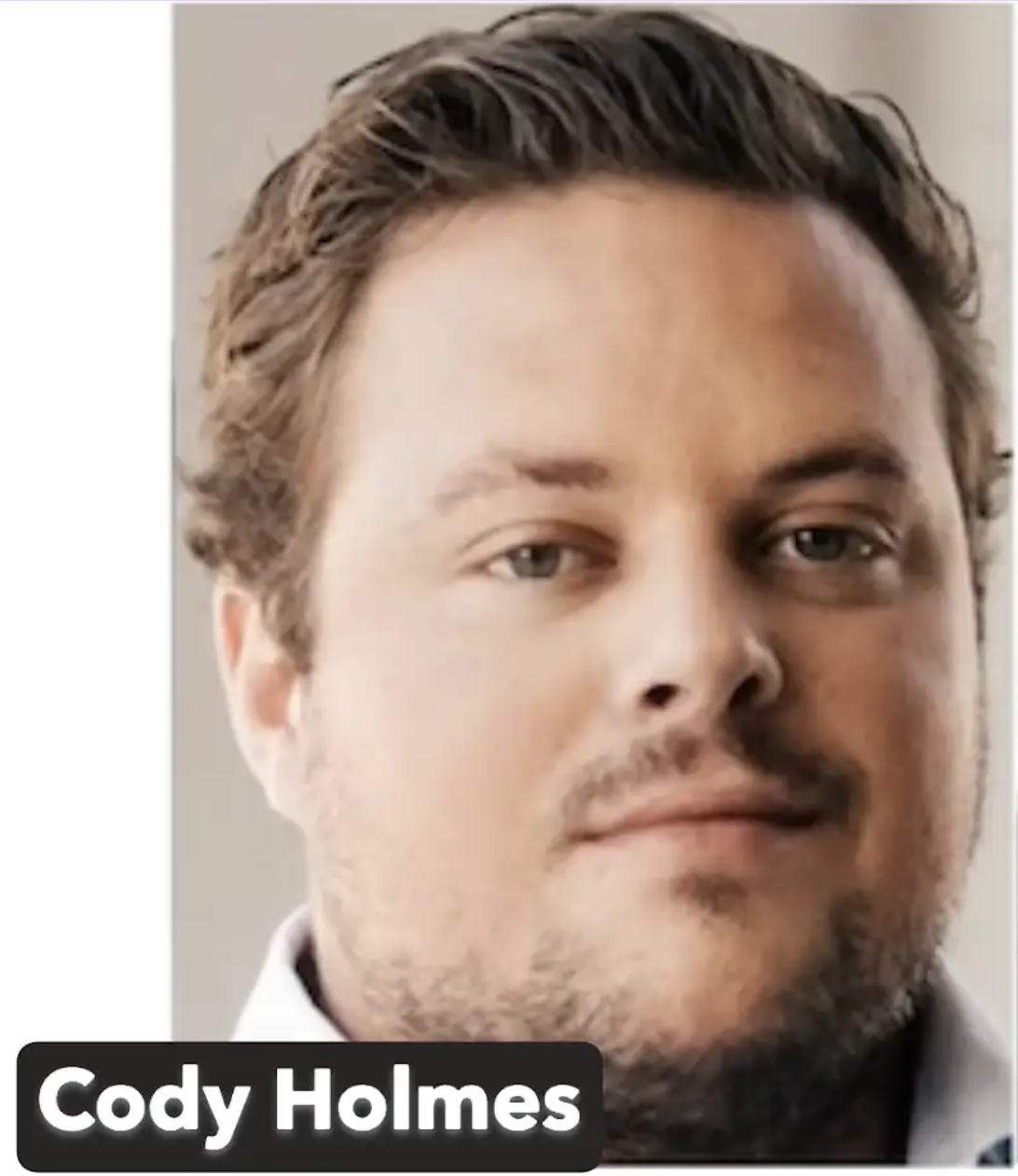
Cody Holmes
Defendant Cody Holmes was prosecuted on several federal felony charges in the defrauding taxpayers out of homelessness funds. The Central District of California published the same press release regarding Cody’s prosecution as that of Steven Taylor.
He was then later transferred for prosecution in Santa Ana California, likely due to protection and conditions for his release while on bail.
The case of Cody Holmes in Santa Ana is United States v. Holmes Case Number 2:25-cr-00929.
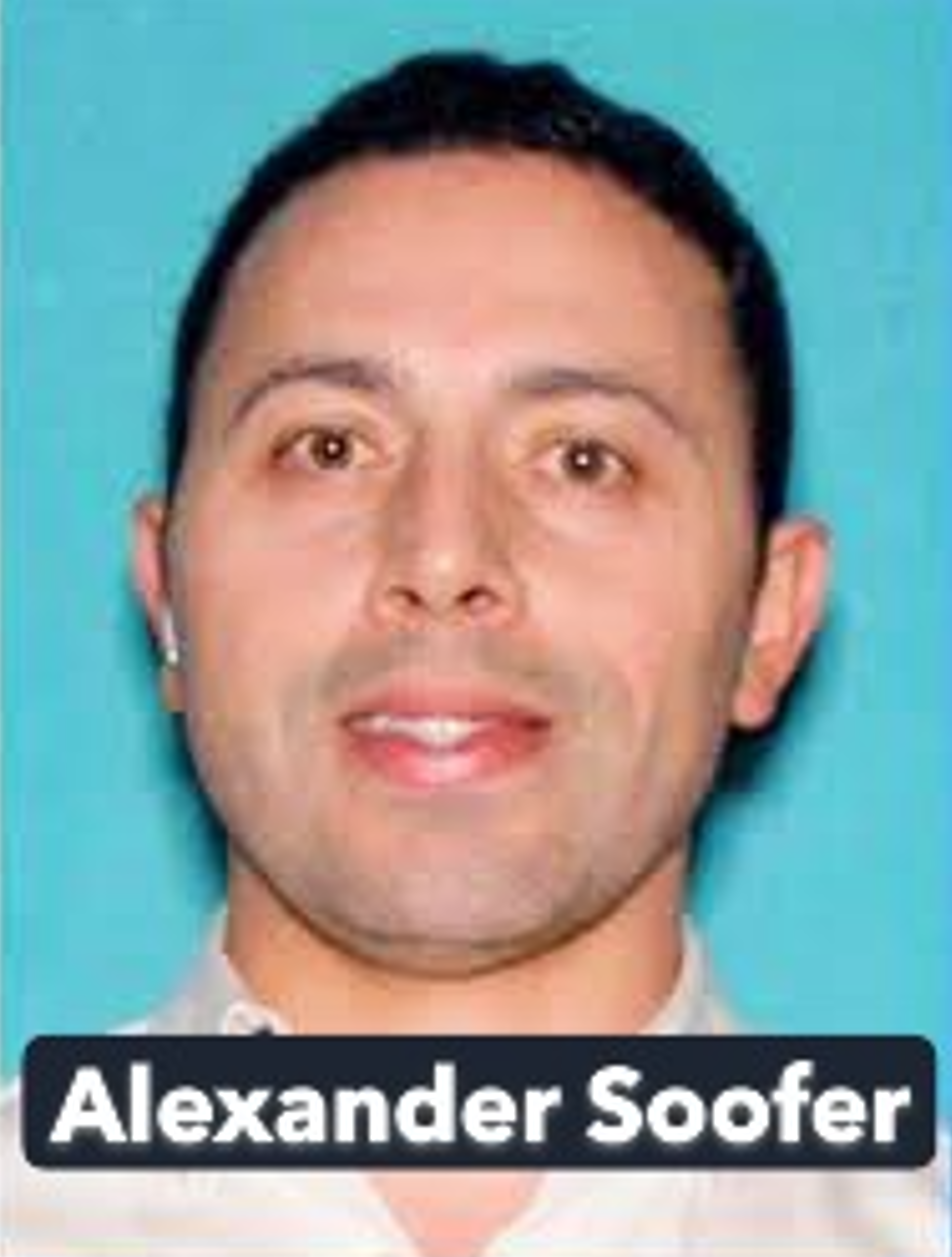
Alexander Soofer
Alexander Soofer, CEO of the non-profit Abundant Blessings, faces state and federal felony charges for stealing taxpayer funds meant for homeless services. His state case, People v. Alexander Soofer (Case No. 26CJCF00450), is currently being prosecuted by the Los Angeles County District Attorney’s Office.
You can also read the Los Angeles District Attorney’s Office press release by clicking here.
If the link to the press release does not work, you can also view the DA’s press release in PDF format by clicking here.
The Los Angeles US Attorney’s Office also published a press release on Soofer’s prosecution as well.
And at a hearing in February 2026, in open court, the U.S. Attorney’s office said more arrests were coming. The civil case established that the City could not account for what its taxpayer money bought. The criminal cases are beginning to establish where some of it went. Those are different findings, made by different courts, under different standards — and they point in the same direction.
One more thing about the record itself. The full docket of Alliance v. City of Los Angeles as with all the other cases mentioned — the orders, the transcripts, the exhibits — are available free on CourtListener, because this publication bought the filings and uploaded them.
That is the case. But if you think a federal judge supervising a city’s homelessness spending is unprecedented, you are off by more than a decade. The same judge had seen the same behavior before — from the federal government itself, on 388 acres two miles from the courthouse where veterans were sleeping outside the fence.
Chapter 2: The Warning Nobody Heeded
Two private landowners — Arcadia Bandini de Baker and Senator John P. Jones — deeded approximately 300 acres (later expanded to 388) of West Los Angeles to the federal government for a specific purpose: a home for disabled soldiers. For decades it operated as one, with thousands of veterans living on the grounds. Then, over the second half of the twentieth century, the housing wound down, and the land found other uses. By the 2000s, the campus deeded as a soldiers’ home hosted, among other things, a private school’s athletic complex, UCLA’s baseball stadium, commercial oil drilling, and a hotel laundry — while homeless veterans camped along its perimeter fence. Los Angeles County today has more than 3,000 unhoused veterans, the largest such population in the country.
The First Lawsuit - Valentini vs Shinseki
On June 8, 2011, disabled homeless veterans and the ACLU of Southern California sued the Secretary of Veterans Affairs in Valentini v. Shinseki. On August 29, 2013, the district court ruled that the challenged land-use agreements on the campus were “unauthorized by law” and void — the federal government had no legal authority to lease a veterans’ home to third parties for purposes that did not principally serve veterans. In January 2015, the VA settled: it adopted a master plan and promised roughly 1,200 units of permanent supportive housing on the campus, with more than 770 to be completed by 2022. Congress then moved with the West Los Angeles Leasing Act of 2016, which wrote the limits into statute.
Then, the VA simply did not do it. The VA’s own Office of Inspector General documented the noncompliance — in 2018, and again in 2021. Some voided lease arrangements were renewed in new forms. The housing deadlines passed with a fraction built. A federal court order, a signed settlement, and a federal statute produced, on the ground, years of delay. Keep that sequence in mind, because it is the exact sequence the City of Los Angeles would repeat with the Alliance settlement: commitment, statute-grade formality, noncompliance, and no consequences until a court ran out of patience.
The second lawsuit: Powers vs McDonough
So, the veterans sued again. Powers v. McDonough, a class action by unhoused veterans with serious mental illness and traumatic brain injuries, presided over by Judge David O. Carter — the same judge presiding over Alliance. After a four-week bench trial, Carter issued a 124-page ruling on September 6, 2024. He found the leases with the UCLA Regents, Brentwood School, and the Bridgeland oil operation unlawful and voided them. He found that the VA had discriminated against disabled veterans in violation of the Rehabilitation Act by failing to provide supportive housing on land deeded for exactly that purpose. And he ordered the VA to build: 750 temporary units and 1,800 permanent units on the campus.
The VA appealed — the same reflex the City would show a year later. On December 23, 2025, the Ninth Circuit largely affirmed. Writing for the panel, Judge Ana de Alba found the agency had “strayed from its mission,” upheld the Rehabilitation Act discrimination findings and the housing order in full — 750 temporary units within 18 months, 1,800 permanent units within six years — and upheld the invalidation of most of the commercial leases, including the private school’s 22-acre sports complex and the oil-drilling license.
Why This Section Exists
Two reasons, and neither is sentiment.
First, the pattern. Land deeded for the destitute was redirected to private benefit; the revenue went unaccounted for; a court order, a settlement, and a statute all failed to change the behavior; compliance began only under sustained judicial supervision. That is the same institutional behavior the Alliance record documents with money instead of land, a decade later, in the same city. When two different governments — federal and municipal — produce the same sequence with the same population, the explanation is not one bad administrator. It is structural: institutions in this system do not deliver for the poor unless a court stands over them, because nothing in the system’s ordinary incentives requires them to.
Second, the judge. When the Alliance case was assigned to Judge Carter, it landed in front of the one judge in the district whom the veterans’ record had already educated — a judge who had personally watched a government promise housing, sign a settlement, ignore it, get caught by its own inspector general, and ignore that too. When Carter refused to accept the City’s unverified numbers in 2025, he was not being aggressive. He was applying experience. He had seen what these commitments are worth without verification, because the VA had shown him.
Fifty years of this, on one piece of land, is not an accident, and neither is the Alliance record. Which raises the question the next section answers: where were the officials whose actual job was to catch all of this before it required a federal judge? Every City contract, every outside-counsel engagement, every settlement in this story passed across one desk. Section 3 is about that desk.
Chapter 3: The Los Angeles City Attorney’s Office as the Gatekeeper
Both cases in the last two sections ended the same way: a federal judge had to order a government to do what it had already promised in writing to do. That should prompt an obvious question. Cities and agencies employ lawyers precisely to keep this from happening. Where were they?
In Los Angeles, the answer runs through one office.
What the Office of the Los Angeles City Attorney Actually Does
The Los Angeles City Attorney is not a staff lawyer. The position is elected citywide, and under the City Charter it holds three powers that matter for this story. First, no City contract takes effect until that office approves it as to form and legality. Second, the office controls the City’s litigation — what to fight, what to settle, what to appeal. Third, when the City hires outside counsel, that office selects and supervises them. The office’s own published materials describe roughly a thousand legal professionals working under the City Attorney’s direction and supervision.
Put those three powers together and you get the point of this section. The $7.5 million taxpayer funded Gibson Dunn engagement described in Section 1 did not appear by accident, and neither did the decision to fight the fee award, move to disqualify the judge, and appeal. Those are litigation choices, and litigation is what this office controls. The reasonable reading of the record, offered as a reading and not a document: an engagement of that size, and the identity of the partner leading it, does not exist outside the City Attorney’s knowledge and approval. That is not an accusation of wrongdoing. It is a description of what the office is for.
Who Held The Office
Hydee Feldstein Soto was elected City Attorney in 2022. Her professional background, per her own published resume, is worth stating plainly because it is unusual for the job. She has zero criminal prosecution experience. She spent roughly a decade as an equity partner at Paul Hastings, then joined Sullivan & Cromwell as an equity partner from 2007 to 2012, where she co-chaired the firm’s Global Leveraged Finance practice and its Bankruptcy and Restructuring practice. That is a career built on corporate debt — structuring it, syndicating it, and unwinding it when it fails.
We published a comprehensive piece showing a highlight reel of Hydee Feldstein Soto’s blatant corruption during her tenure as City Attorney, which you can read by clicking here.
Therefore, consider the sequence. A city carrying billions in voter-approved government bond debt for homelessness programs, in the middle of a documented failure to deliver what that debt was sold to build, elected as its chief legal officer a career leveraged-finance lawyer and local elections for Los Angeles City Attorney generally always have a record low turnout. It is a fact about what kind of expertise the City chose to put in charge of its legal affairs, and about what that expertise is trained to see — and what it is trained to treat as normal.
In June 2026, voters denied her a second term. She placed third in the primary, an extremely unusual failure for an incumbent. Note what that does and does not change. The officeholder is gone; the contracts, the outside-counsel arrangements, the bond obligations, and the reporting practices all survive her. That is this article’s argument about structure in miniature. An election removed a person. It did not touch the machine.
June 2026: The City Attorney’s Office Turns Against LAFLA and Kahn Scolnick
Then, two weeks before the City Attorney election, the Office of the City Attorney produced the single most useful document in this entire article — and it produced it against its own political interest, which is part of why it is credible.
On June 15, 2026, the City Attorney’s office issued a public statement and a report to the City Council, R26-0340, explaining why the City’s eviction defense and tenant services contracts had not been finalized. The report lays out the history of the program’s main contractor, the Legal Aid Foundation of Los Angeles (LAFLA).
In 2021, LAFLA received a $7 million taxpayer funded pilot contract from the City. It was awarded without competitive bidding, using an exception to the Charter’s bidding requirements for exigent circumstances related to the COVID-19 pandemic. Over the following years, that contract was amended and extended nine times. It grew to more than $90 million in taxpayer dollars. And in the office’s own words, all that growth happened “without the information, access and reports required by the original $7 million taxpayer funded original agreement.”
Read that carefully, because it is a confession as much as an accusation. A contract that skipped competitive bidding on an emergency rationale grew thirteenfold over five years while the reporting requirements built into the original award went unenforced. The City Attorney’s office is telling the City Council that the City’s own oversight terms were not applied to $83 million in additional taxpayer money spending. Nobody outside the City government found that. The City’s own lawyers put it in a report to the City Council.
What The Negotiation Emails Show
R26-0340 includes the underlying correspondence, which is more informative than any characterization of it. In the spring of 2026, the City tried to write standard accountability terms into the new contract, and LAFLA’s negotiators pushed back on specific ones.
Two exchanges matter. On the reporting of case numbers — the data that would let the City verify that the cases it paid for were actually handled — LAFLA’s legal director wrote that the organization was willing to provide case numbers as part of an audit, but did not think it should provide that information as part of regular data reporting, citing record sealing, and asked that it be moved under the audit provisions instead. On invoicing, after objecting that the documentation requirements were burdensome and uncompensated, LAFLA proposed a trade: it would accept the invoicing provision as written if it could instead bill 15 percent indirect costs across the board for itself and its subcontractors, without the federal modified-total-direct-cost basis, on the reasoning that this was not federal funding.
The City’s position, stated in the same report, was that LAFLA had argued City funds should not carry oversight as robust as federal funds, and that the office disagreed — that taxpayer dollars are entitled to the same industry-standard reporting and auditing either way. The City Attorney’s public statement used the word “unconscionable” to describe LAFLA’s refusal to agree to the accountability and reporting requirements needed to finalize the contracts.
This exchange began as your typical run of the mill contract negotiation. Nonprofits routinely and legitimately push back on administrative burdens that unnecessarily consume money meant for services. Indirect-cost rates are a real and contested issue across the entire nonprofit sector.
But we need to be equally clear about what these two requests, taken together, would have produced: less routine visibility into whether the work was performed along with a higher fixed percentage taken off the top. That is the substance of what was asked for, regardless of the reasons offered. To make matters worse, the organization asking (LAFLA) is the one that derives roughly three-quarters of its total revenue from government contracts, according to its own audited financial statements included in the same report.
The Wires Cross - Kahn Scolnick, LAFLA, Gibson Dunn Crutcher, and The Federalist Society
One more fact completes this section, and it is the reason the section exists where it does.
The organization the City Attorney publicly accused of resisting oversight on more than $90 million in taxpayer money is chaired by the same lawyer who led the City’s defense in the Alliance case — Kahn Scolnick — an engagement that ran through the City Attorney’s own office.
The City Attorney and LAFLA were, by June 2026, publicly at odds. And even in open conflict, the two institutions shared a board president and lead counsel in the same person. That is not a secret arrangement. It is a small professional world in which the same people occupy the seats on both sides of a dispute, in public, and nobody involved appears to have treated it as a problem worth documenting.
So who is that lawyer? Section 4 is about him.
Chapter 4: Kahn Scolnick and The Federalist Society
Everything in this article so far has been about institutions: a court, a city, an office. This section is about one person, because the entire argument runs through a set of choices that one person made and a set of institutions permitted. The facts below come from public records — court dockets, LAFLA’s own publications, IRS filings, the State Bar’s own correspondence, and Gibson Dunn’s own website.
Who is Kahn Scolnick
Kahn Abrahm Scolnick license number 228686 is a licensed California lawyer and named partner at the Gibson Dunn Crutcher law firm. He has a brother named Chase Scolnick who also works as a California lawyer at the firm of Keller Anderle Scolnick.
Kahn Abrahm Scolnick, California State Bar #228686, is a partner in the Los Angeles law firm office of Gibson, Dunn & Crutcher. His Gibson Dunn law firm biography lists a clerkship with Judge Ferdinand F. Fernandez of the Ninth Circuit Court of Appeals (2005–2006) and, before that, with Judge Dana M. Sabraw of the Southern District of California. He has been recognized by Best Lawyers in America and The Legal 500. By any normal measure, he is an accomplished, well-credentialed appellate and trial lawyer.
He is also a repeat player in cases involving city government interests. The Second District Court of Appeal’s own attorney-search database returns twenty-two matters in which Scolnick appears as counsel of record, including City of Los Angeles v. HRRP Garland, LLC (case numbers B340900 and B342338, consolidated). Representing government entities and large institutions is not unusual for a Gibson Dunn partner, and there is nothing wrong with it on its own. It matters here because of what else he was doing at the same time.
The law firm of Gibson Dunn Crutcher boasts as having an army of lawyers operating internationally, over 1,800 across 20 global offices to be exact. The number of lawyers operating just in their Los Angeles office amounts to approximately 557. When put into perspective, out of 557 lawyers, why would a leading multinational law firm choose the ONE guy in Los Angeles who has an obvious conflict of interest to be the lead lawyer?
The Two Roles Kahn Scolnick Held - Legal Aid Foundation of Los Angeles Board President and City of LA Lawyer
Role one: lead defense counsel for the City of Los Angeles in LA Alliance for Human Rights v. City of Los Angeles, the federal case described in Section 1. Court records place him in that role at least through trial in May and June 2025, through the June 2025 order finding the City in breach of its settlement obligations, and through the City’s appeal to the Ninth Circuit. The City paid Gibson Dunn roughly $7.5 million of taxpayer money for that defense.
Role two: President of the Board of Directors of the Legal Aid Foundation of Los Angeles. LAFLA’s annual reports and its public website list Scolnick as Board President from 2022 to 2024 and again from 2024 to the present. Screenshots of both are preserved in the State Bar record described below. His own Gibson Dunn biography states it plainly: “He serves as the president of the Legal Aid Foundation of Los Angeles.” This was not hidden. It was published by both organizations, continuously, for years.
LAFLA’s stated mission is legal services for low-income and unhoused people in Los Angeles — the population at the center of the Alliance case. LAFLA is not a bystander to City business, either. As Section 3 laid out, it holds City contracts that grew from a $7 million taxpayer funded pilot project in 2021 to more than $90 million taxpayer monies across nine amendments, and in June 2026 the City Attorney publicly accused it of refusing standard audit oversight terms.
So, during the same years, the same lawyer (1) defended the City in federal litigation about its treatment of homeless residents and its handling of homelessness money, and (2) led the board of the legal aid organization that serves those same residents and that itself holds tens of millions of dollars in City contracts. Neither role was a technicality. Lead defense counsel is the person shaping the City’s litigation strategy. Board President is a fiduciary officer with executive power — under LAFLA’s own governance documents, the Board of Directors supervises, controls, and directs the organization.
California State Bar Professional Rules of Conduct Rule 1.7 - Conflict of Interest Clause
California Rule of Professional Conduct 1.7 governs conflicts of interest for every licensed lawyer in the state. The part that matters here is not just the familiar “two clients on opposite sides” scenario. Rule 1.7(a)(2) also prohibits a lawyer from representing a client when there is a significant risk that the representation will be materially limited by the lawyer’s responsibilities to or relationships with a third person or organization. A board presidency is exactly that kind of responsibility. The question the rule asks is whether Kahn Scolnick’s fiduciary duties to LAFLA created a significant risk of limiting his judgment while defending the City in litigation about LAFLA’s own client population (as well as vice versa) — and, if so, whether the conflict was properly identified, disclosed, and consented to.
One more document is relevant. LAFLA’s IRS Form 990 filings state that the organization has a written conflict-of-interest policy, and that officers and directors are required to disclose interests that could give rise to conflicts. In other words, the organization Kahn Scolnick led attests, in its own federal tax filings, that it maintains exactly the kind of conflict-screening process this situation would trigger. What that process produced in his case — a disclosure, a waiver, a recusal, or nothing — is not public and should be.
You should also be aware of a SCOTUS ruling on the issue of licensed lawyer conflict of interest – the capability and competency of the client to even be able to object to such a conflict as well as the innate obligation a lawyer has to NOT take up such positions, including when there's even a remote possibility of unintended consequences of impropriety.
The State Bar Complaint - Step by Step
On January 16, 2026, a member of the public filed a misconduct complaint against Scolnick with the State Bar’s Office of Chief Trial Counsel (OCTC), alleging that the dual roles violate Rule 1.7. The complaint cited the court dockets for the Alliance representation and LAFLA’s own website for the board presidency.
On February 10, 2026, OCTC closed the complaint without investigating the merits, especially with respect to section 1.7(a)(2). The closure letter, signed by Trial Counsel William Todd, gave two reasons: first, that the complaint did not identify facts showing the City had not been informed of, and consented to, the LAFLA role; and second, that Scolnick’s communications with the City are protected by attorney-client privilege, so the Bar could not ask him about them absent a waiver.
Read that reasoning carefully, because it is worth being fair about what it does and does not say. The Bar did not say there was no conflict. It said that whether the City consented is unknown, and that privilege prevents the Bar from asking. The predicate facts — the two simultaneous roles — were not disputed.
On February 17, 2026, the complainant appealed to the Bar’s Complaint Review Unit (CRU). The appeal runs seventeen pages with eleven exhibits: California Secretary of State records establishing LAFLA’s corporate governance structure, LAFLA’s founding and governance documents, the Attorney General’s charitable-trust registry entries, the Form 990 filings, the Second District appearance records, the current Rules of Professional Conduct, and the preserved screenshots of both board terms. Its core legal argument tracks what Rule 1.7(a)(2) actually says: a material-limitation conflict does not require a second client, and a closure that treats “no formal attorney-client relationship with LAFLA” as an off-ramp never reaches the question the rule poses.
On March 5, 2026, the CRU acknowledged the appeal and estimated that review could take ten months or more. On June 22, 2026, the complainant supplemented the file with the City Attorney’s June 15, 2026 press release about LAFLA — the document described in Section 3, in which the City’s own chief lawyer accused the organization Kahn Scolnick chairs of refusing compliance, reporting, and oversight provisions on public funds. The appeal is pending at the time of this article's publication and future edits will reflect its eventual disposition. Whatever the Bar ultimately decides, one thing it has not done, anywhere in this record, is dispute the underlying facts.
There is one more observable fact worth recording, and it needs no interpretation. Before the complaint, Scolnick appeared at the Alliance case’s public status hearings. After the complaint was filed in January 2026, he stopped. He has not been seen at the subsequent hearings, including the quarterly status conferences that continue under the settlement, but his name as lead counsel is still attached to the case.
The Second Scolnick - Chase Scolnick
In the months after the civil case ended, prosecutors began criminally charging people with stealing homelessness money. One of the first was Alexander Soofer, a nonprofit executive of the organization named Abundant Blessings. The Los Angeles County District Attorney and the U.S. Attorney for the Central District of California both announced charges against him in press releases; his state felony case number is 26CJCF00450.
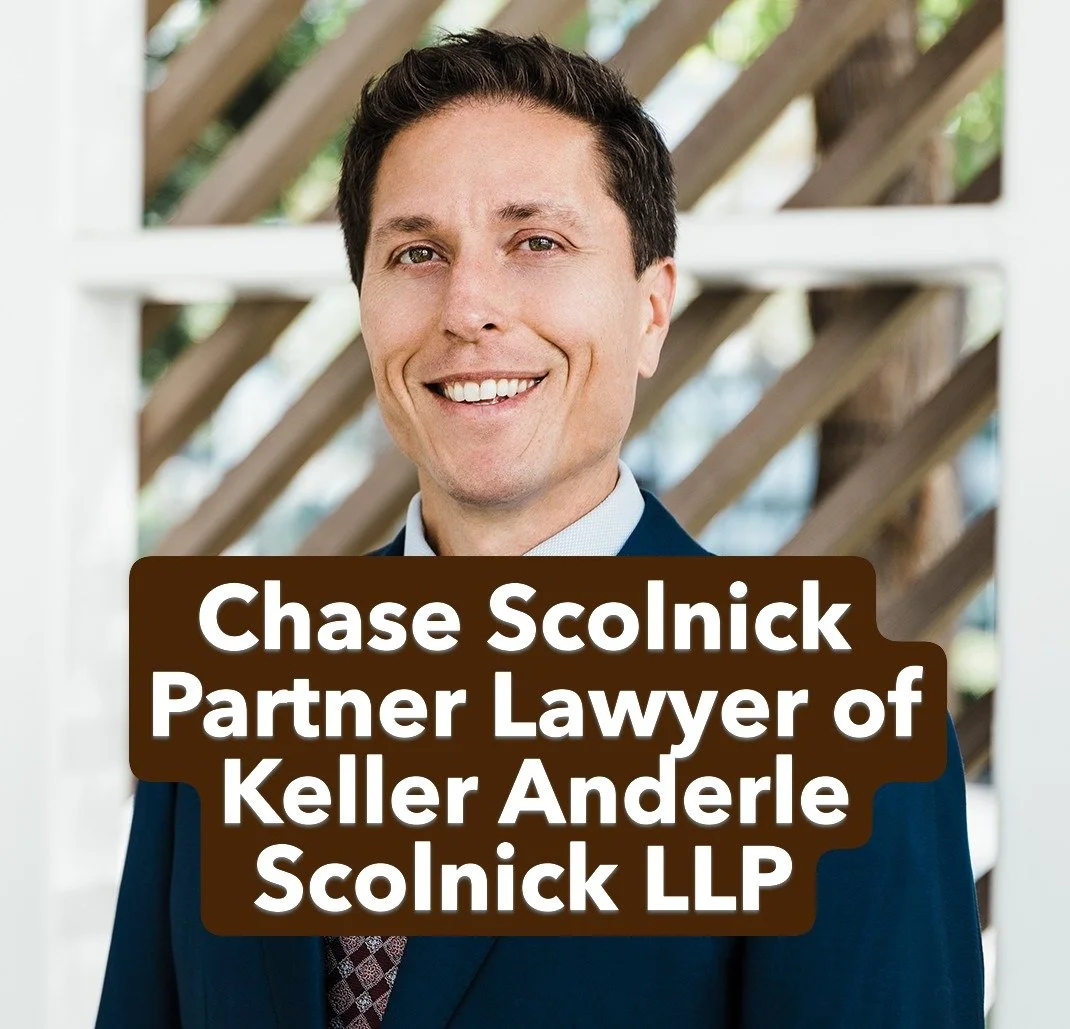
Chase Scolnick
Chase Scolnick license number 227631 is a lawyer and named partner at the Keller Anderle Scolnick law firm.
Chase Scolnick is the brother of Kahn Scolnick.
Chase is the lead defense lawyer for defendant Alexander Soofer in the felony case prosecuted by the Los Angeles District Attorney’s Office over homelessness fraud.
Soofer’s lead defense lawyer is Chase Scolnick, a name partner at Keller Anderle Scolnick LLP. Chase Scolnick is Kahn Scolnick’s brother.
Take the relationship as documented and here is the picture: one brother defended the City in the civil case that put the misuse of homelessness funds on the public record; the other brother now defends one of the first people criminally charged with stealing those funds. Los Angeles has a small elite defense bar, and family members practicing law in the same city is common. But when the same family name appears on the civil defense of the government and the criminal defense of the accused, in the same scandal, the public is entitled to ask ordinary questions: who is paying each retainer, who referred each engagement, and to what degree is there comingling. Those questions have documentary answers. A subpoena, a discovery request, or an Inspector General with real authority could easily produce them.
The law firm of Gibson Dunn Crutcher
A word about the law firm of Gibson Dunn itself, because the firm reappears in Section 6. Gibson Dunn is one of the largest law firms in the world, with a client list that runs from multinational corporations to foreign governments. In the Alliance case, it did what defense firms do: it fought. It contested the fee award. It filed the City’s motion seeking to remove Judge Carter from the case. It carried the appeal until the City abandoned it in May 2026. None of that is misconduct; it is advocacy, and the City chose to use our taxpayer dollars to fund it.
The point is narrower. A law firm of that size runs formal conflict checks on every engagement. The City’s engagement of Gibson Dunn ran through the City Attorney’s office, as Section 3 explained. LAFLA’s board roster was published on its own website. Every institution in this chain — the firm, the nonprofit, the City — had the information and the procedures to catch this. The record contains no indication that any of them acted on it. That is the fact this article keeps returning to: the problem was never secrecy. Everything was published. The problem is that publication changed nothing, because no one whose job it was to object had any incentive to, thus reasonably leading to infer conspiracy.
It also boasts over 1,800 lawyers across its 20 global offices, with over 500 of those lawyers operating at their Los Angeles office.
Chapter 5: The Machine That Pays For All - Government Bonds
Nothing in the last four sections pays for itself. The $7.5 million taxpayer funded defense, the $90 million taxpayer monies in tenant-services contracts, the housing that was supposed to be built — all of it is financed the same way, by an instrument most voters have approved without ever being told how it works.
This section explains it, using Los Angeles’s own audited numbers.
How a Government Bond Measure Actually Works
When you vote for a housing bond, you are not voting to spend money the city has. You are voting to let the city borrow, by selling bonds to investors, and to commit yourself and every other property taxpayer to repaying those investors with interest over the next several 20+ years.
The moment the bonds are sold, a set of professionals gets paid upfront using existing taxpayer dollars. Underwriters take a spread for placing the bonds. Bond counsel is paid for the legal opinion that makes the deal marketable. Financial advisors are paid for structuring it. Rating agencies are paid to rate it. Those fees are earned at issuance, calculated off the size of the borrowing, and they do not depend in any way on whether a single unit of housing ever gets built.
Then the building is supposed to happen, over the following decade, managed by agencies and developers and consultants who are also paid using taxpayer money along the way. The taxpayer’s obligation begins immediately and runs for a generation. Verification of results, if it happens at all, comes years later, from an auditor with no power to claw anything that was spent back.
That structure is the whole story. Taxpayer money is collected up front by people whose compensation is tied to the size of the transaction, regardless as to whether the desired outcomes are achieved. Results are measured much later, by people with no authority to undo anything that was already spent. Nobody in the chain is paid for delivery, and nobody loses money for failure.
Proposition HHH Explained by the City’s own City Controller and Auditors
In November 2016, Los Angeles voters approved Proposition HHH: $1.2 billion in general obligation government bonds to build supportive housing, promoted with a promise of about 10,000 units.
The City Controller audited the program in 2019. The findings: median cost per unit of $531,373, against an original estimate of roughly $350,000. More than a thousand units projected to cost over $600,000 each. Soft costs — consultants, permitting, financing — running 35 to 40 percent of construction budgets. And the expected number of supportive units already revised downward, to 5,873.
The City Controller audited again in 2022. By then, more than five years after the vote, roughly 1,142 units had been completed. Some projects were approaching $837,000 per unit on the conservative end. The audit described the pace of completion as wholly inadequate. It also found that the City had sold bonds years before it needed the proceeds, costing taxpayers more than $5 million in unnecessary interest, and that no single department was accountable for program-wide accounting.
Set those numbers next to each other. Voters approved $1.2 billion taxpayer monies for 10,000 units. Five years later they had roughly 1,142 units, some costing more than twice what a median Los Angeles home cost when the measure passed, financed by debt that had been issued early enough to waste $5 million of taxpayer money just in interest, with no department in charge of the arithmetic. And the taxpayers are still repaying every dollar of it, on schedule, for decades.
The Building that was Already There - Oceanwide Plaza
While all of that was happening, three finished towers stood empty in the middle of downtown Los Angeles.
Oceanwide Plaza is a $1.2 billion, three-tower complex next to Crypto Arena and the Convention Center, in the densest concentration of homelessness services in the county. Construction began in 2014. By early 2019 the structures were substantially built — frames, floors, stairs, and windows. Then the work stopped, and it stopped for a reason that had nothing to do with Los Angeles: the Chinese government imposed controls on outbound investment, and the Beijing-based developer could no longer fund the project. The contractors stopped being paid and left.
The buildings have stood there ever since. In early 2024 they were covered in graffiti across some twenty-five floors and became a destination for base jumpers, and the City spent public taxpayer money on fencing and security — about $1.1 million in taxpayer dollars approved in February 2024 — then voted to bill the absent owner roughly $4 million for the cleanup and barriers. The general contractor filed an involuntary bankruptcy petition against the developer that same month; creditors were owed close to $400 million, among them EB-5 investors, foreign nationals who had financed the construction in exchange for U.S. immigration benefits.
The resolution came in 2026. A bankruptcy judge approved a settlement among the creditors in February, establishing who got paid in what order. Days later a buyer filed a $470 million purchase agreement, and graffiti removal began this summer. In their filings, the developer’s lawyers explained the urgency: prompt sale and completion was a public priority, they wrote, particularly with the 2028 Olympics coming to Los Angeles.
Follow the decisions in that sequence. Beijing’s capital controls determined when construction stopped. A federal bankruptcy court’s distribution waterfall, negotiated among creditors including foreign investors who had bought immigration status, determined when it could restart. An Olympic deadline supplied the urgency. The City of Los Angeles appears in that entire chain exactly once, in the role of paying for a fence.
No one in Los Angeles voted on any of it. And during the same years, a federal judge was finding that the City could not prove what it had done with $1.2 billion in borrowed housing money — while the City spent public funds guarding a substantially finished high-rise from the people who had nowhere to sleep four blocks away.
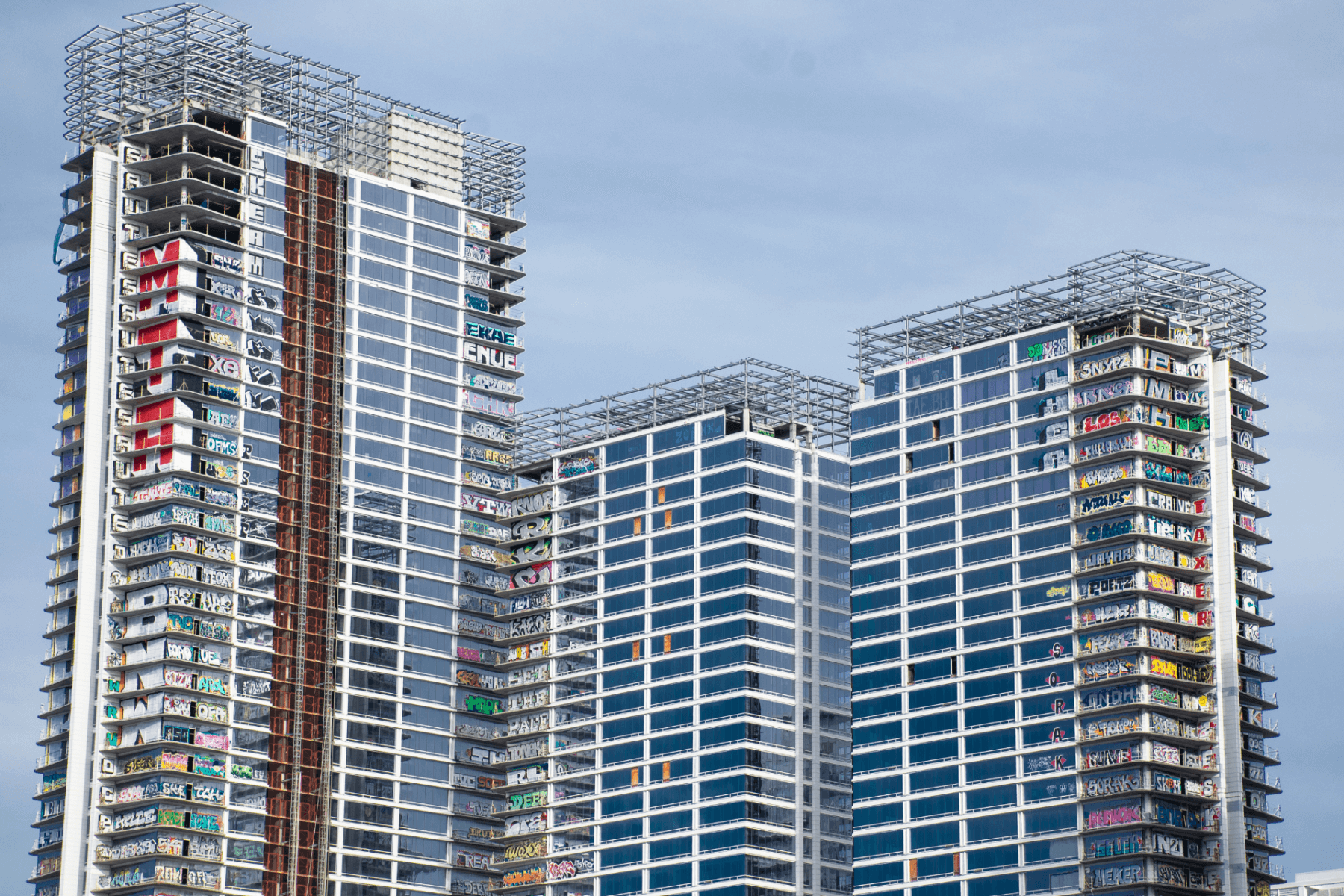
Oceanwide Plaza in downtown Los Angeles. Also known as “Graffiti Towers”.
Not Just Incompetence
It is tempting to read the HHH numbers as exclusively just incompetence. Some of it surely is. But incompetence does not explain why the errors run in one direction, or why they recur across decades, agencies, and governments.
A more useful reading is that the structure works exactly as designed for the people inside it. The bond measure is politically irresistible: the need is real and visible, the ask is framed as compassion, and the cost is deferred past the next several elections. It is also the only absolute guaranteed form of income banks have because they are backed by the full weight of the government to forcibly extract taxes from its people.
It generates immediate, guaranteed fees for a professional class — underwriters, counsel, advisors, developers, consultants — whose income scales with the size of the borrowing and not with the delivery of housing. And it makes failure nearly invisible, because the failure surfaces a decade after the ribbon-cutting, in a document almost nobody from the public reads until it's too late, at a point when the officials who sold the measure have moved on and the money is gone.
The compassion is the sales pitch. The debt service is the product. The unhoused person is the reason the borrowing is politically possible and is the one participant in the entire transaction who receives nothing guaranteed.
The Same Financial Instruments and Institutions in Los Angeles Are International
Los Angeles is a specimen, not an exception. According to the Bank for International Settlements (BIS), total debt securities outstanding worldwide exceeded $156 trillion as of August 2025, roughly 40 percent of it denominated in U.S. dollars. Government issuance dominates that market: the OECD’s (Organization for Economic Co-operation and Development) own dataset puts government bonds at about $53 trillion against $25 trillion in corporate bonds, with U.S. paper making up 55 percent of the combined total. School bonds, transit bonds, water bonds, and housing bonds in every American city run on the same mechanics described above, and above them sits the market for federal debt, operating on the identical principle at national scale.
Who holds it is changing, and the OECD has flagged the change itself as a risk. Across its member countries, foreign investors’ share of sovereign debt rose from 29 percent in 2021 to 34 percent in 2024, while central bank holdings fell from 29 percent to 19 percent and household holdings more than doubled. Central banks hold debt for policy reasons and do not panic. The investors replacing them hold it for yield. That decades-long interest is what yields these massive returns. The OECD’s own conclusion is that sustaining current debt levels will require drawing in new and more price-sensitive investors, which it warns could increase volatility. In other words, another total economic crash but globally.
This is where the article makes its largest claim, and it is stated as the argument of this publication rather than as a finding of any court.
Public borrowing works because buyers believe in the ledgers. They believe the tax base is real, the accounting is honest, and that the money borrowed for a stated purpose was actually spent on it. Every one of the audits described above is evidence that in at least one large American city, for at least one large program, that belief was not warranted by evidence. When a government cannot produce reliable data on what its money bought — which is precisely what a federal judge found in Section 1 — the integrity of its ledgers is not a bookkeeping matter. It is the asset the whole system is borrowing against.
That is what makes this a sovereignty question, and it is worth being precise about which question it is. The point is not that foreign capital is buying American debt; capital has passports but debt markets do not care about them. The point is that decisions with generational consequences for American cities are increasingly made by people accountable to no electorate at all — the underwriters, advisors, rating agencies, and institutional buyers who price and structure the borrowing — while the electorate that repays the debt gets one vote on a ballot measure written in the language of compassion and never sees the accounting again. A government that borrows against ledgers it cannot verify has already transferred some of its self-governance to whoever is willing to keep lending against the fiction.
The Real Money Maker - Interest Costs and Banks as the Major Buyer in Bond Markets
Here is what that borrowing costs now, in the federal government’s own accounting.
Total federal debt passed $38 trillion in October 2025, with about $30.4 trillion of it held by the public — roughly the size of the entire American economy, and the highest ratio since 1946. Net interest in fiscal 2025 came to $970 billion, and the Congressional Budget Office reports that interest on publicly held debt passed $1 trillion for the first time that year. That is more than the United States spent on national defense, a finding confirmed by the Government Accountability Office. It is now the third-largest item in the federal budget, behind Social Security and Medicare, and it consumed roughly nineteen cents of every dollar of federal revenue collected.
CBO projects interest reaching about $1.8 trillion a year by 2035 and publicly held debt reaching 123 percent of the economy by 2036. This is not a uniquely American condition: the OECD reports that across its member countries in aggregate, interest payments now exceed government spending on defense.
Understand what that number is. It buys nothing. It builds no housing, treats no one, staffs no school. It is the price of money already spent — including money spent on programs that, as Los Angeles has demonstrated in federal court, cannot be shown to have delivered what they promised. And it grows on its own, because borrowing to cover interest adds to the principal that generates the next year’s interest.
The banking system is where that arithmetic touches ordinary people, and it has already happened once. Commercial banks are among the largest holders of U.S. government debt, with roughly $4.2 trillion in Treasuries and other government securities — close to a quarter of total assets at large banks. When interest rates rose sharply beginning in 2022, the market value of those holdings fell, because bond prices move opposite to rates. In March 2023, Silicon Valley Bank sold securities at a loss to cover withdrawals, the loss became public, depositors withdrew en-masse, and the bank failed in a matter of days. Signature Bank and First Republic followed. The federal government guaranteed uninsured deposits to stop it spreading.
That is the whole chain in one recent, documented episode: government borrowing, held by banks, repriced by rates, converted into a run, absorbed in the end by the public. Nobody needs to predict it. It is on the record, and the exposure that produced it is larger now than it was then.
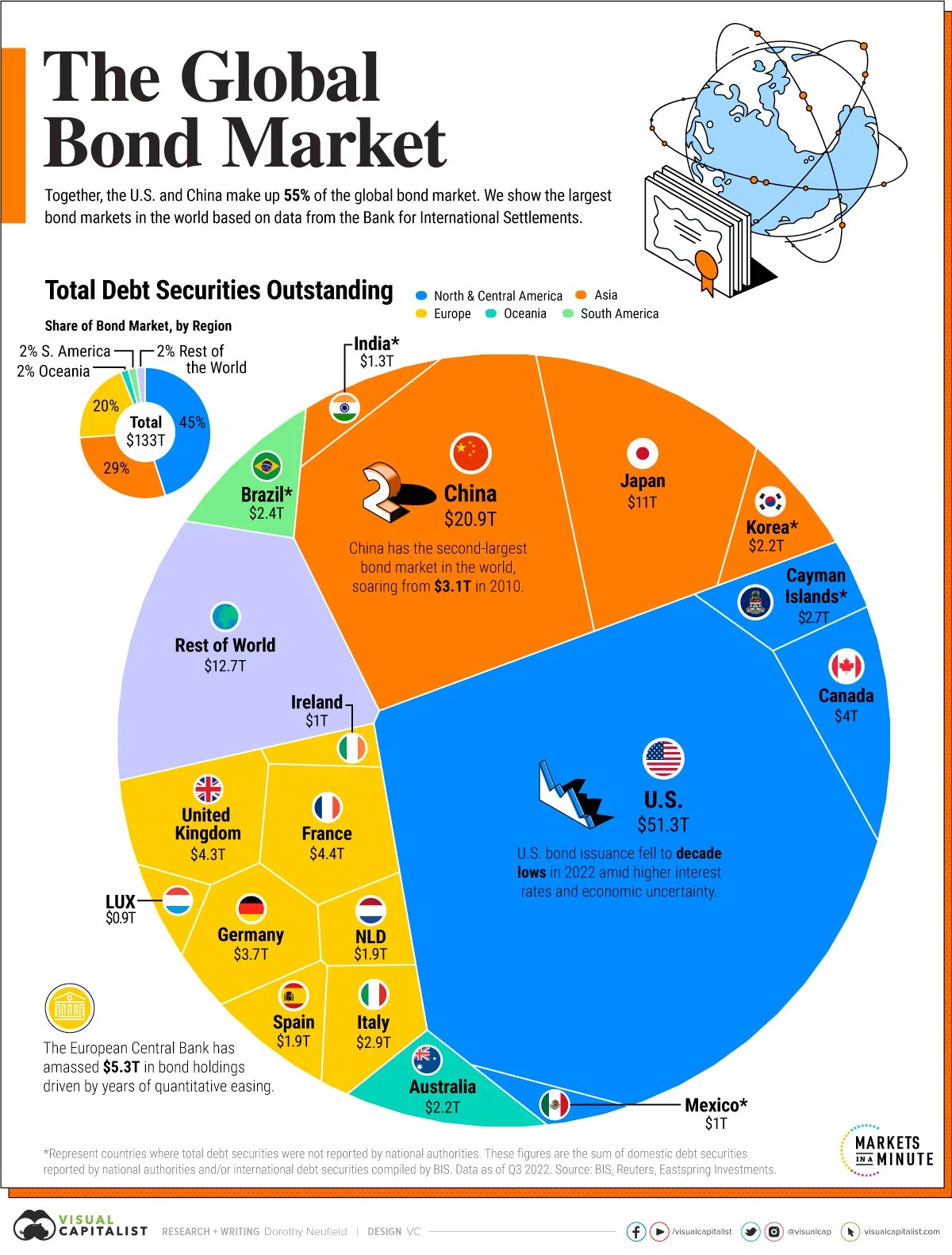
The Global Bond Market dated 2023
Sourced from World Economic Forum article published April 17, 2023 ranking the largest bond markets in the world. America has significantly increased its debt and government bonds hold since this was published.
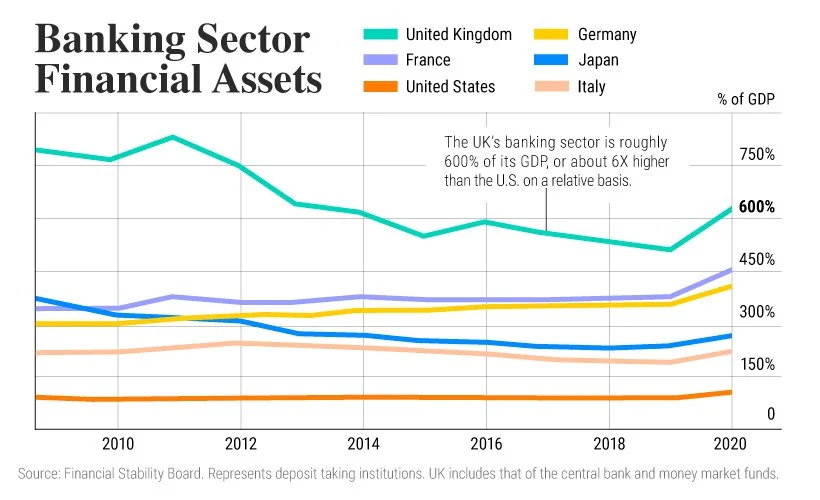
Commercial banks are among top 3 buyers of US government debt.
According to World Economic Forums, this is because commercial banks will reinvest client deposits into interest-bearing securities. These often include U.S. Treasuries, which are highly liquid and one of the safest assets globally. This chart shows the banking sector often surpasses an entire country’s total GDP.
Enter Court Appointed Monitor - Nardello & Co Private Investigative Firm
There is a detail from the end of Section 1 that reads differently now.
When the Alliance case finally resolved, the court did not accept the City’s numbers. It installed an outside monitor at $150,000 a year paid for by taxpayer money: Nardello & Co., a corporate investigations firm staffed substantially by former federal prosecutors and national-security and intelligence professionals, and best known in recent years for its work in the collapse of FTX.
Nobody hires that kind of firm to check whether a housing program is behind schedule. That is a firm you hire to trace where money went, especially because it has ties to international finance. The court, the plaintiffs, and the City all accepted that monitor. The professionals involved in this case appear to understand what category of problem it is, even where the public record so far has been careful to call it a data and compliance failure.
Chapter 6: The Federalist Society and Heritage Foundation are the Ideas Factory
The last section explained the machine: bonds that collect fees up front and defer accountability for decades. Machines need operators — lawyers, judges, politicians, and officials who know how to run them and who can be trusted not to ask the wrong questions. Those people are not born; they are trained, credentialed, and promoted through specific institutions no different than the Mafia and Cartel teach the Omerta code of silence. This section is about the main ideas factory, and it starts with a document that has been sitting in this article’s own record the whole time.
What it describes is a professional culture: a network with journals, conferences, clerkships, donor money, and board seats, whose members hire, promote, and protect each other in the open. The operational conspiracy is not that every character grew up with or is a familial relative to each other, but rather they are interconnected by a web of incentives and institutions that enable predatory behavior.
That is more durable than any "secret cabal" conspiracy, because there is nothing to expose. It is all on their own letterheads.
2008 Federalist Society Newsletter Written by Kahn Scolnick
In October 2008, Kahn Scolnick published an article in Class Action Watch, an official publication of The Federalist Society for Law and Public Policy Studies. The publication itself is in the record of the State Bar appeal. Its subject matter, and the material surrounding his piece, is what makes it worth your time: that era’s fights over whether governments could use public-nuisance theories, and hire outside counsel on contingency, to sue corporations — with the newsletter’s contributors consistently developing the arguments that shielded institutional defendants and narrowed those tools. This is the same era of "tort reform", a nationwide propaganda narrative peddled in large part by The Federalist Society to reduce financial damages that We The People could levy against corporations committing harm, especially large corporations that supported the false and extremist ideologies of The Heritage Foundation and The Federalist Society.
Taken alone, there is nothing inherently improper about a young lawyer publishing in a professional newsletter. The point is simpler: seventeen years before he defended the City of Los Angeles in a case about public accountability, Kahn Scolnick was already writing inside the network whose central intellectual project is limiting the ways the public can hold institutions accountable in court. The career that followed is consistent with the publication.
The Federalist Society logo
The Lobbyist Pipeline
The Federalist Society was founded in 1982 as a student debating society. It is now the most effective legal credentialing network in American history. Its national conventions function as a hiring hall for conservative legal talent; its chapters exist at nearly every law school; membership or affiliation is a practical prerequisite for a federal judicial appointment under Republican administrations.
The results are on the Supreme Court. Clarence Thomas and Alito are longtime affiliates and regular speakers at Federalist Society events. Gorsuch, Kavanaugh, and Barrett were each selected from candidate lists curated by The Federalist Society’s longtime leadership during the first Trump administration — a process the administration described openly at the time. Roberts appeared in a Federalist Society leadership directory in the late 1990s, though he has said he has no recollection of being a member. However you count it, a supermajority of the current Court passed through or was vetted by a single private organization. That is not an accusation. It is the organization’s own proudest achievement, and its officials have said so publicly for years.
The Federalist Society Summit and its Ethics Record
The network’s most emblematic member is Clarence Thomas, and his documented ethics record is worth stating plainly, because it establishes what the culture tolerates at its very top. Beginning in 2023, ProPublica published a series of investigations — recognized with the Pulitzer Prize for Public Service in 2024 — documenting that Thomas had, over roughly two decades, accepted undisclosed luxury travel, private-jet and yacht trips, and other financial benefits from billionaire benefactors, principally the real estate developer Harlan Crow; that Crow had purchased real estate from Thomas and his family; and that Crow had paid private-school tuition for a child Thomas was raising. None of it appeared on the financial disclosure forms federal judges are required to file, until the reporting forced revisions.
The money side of the network is documented too. In 2022, ProPublica and The New York Times reported that a little-known Chicago electronics manufacturer, Barre Seid, had transferred his company — valued at roughly $1.6 billion — to a trust controlled by Leonard Leo, the Federalist Society’s longtime executive and the architect of the judicial-selection lists. It was among the largest known political donations in American history, and it funds the network’s litigation and advocacy arms to this day. One more recent detail rounds out the picture: in 2026, when courts — including judges he appointed — blocked parts of his agenda, President Trump publicly attacked Leo by name. The administration’s senior lawyers kept appearing at The Federalist Society’s events anyway. The network is bigger than any politician, including the one it helped elect. That is what an institution is.
This publicly recorded history of blatant corruption predatory behavior by Clarence Thomas sits alongside his sexual abuse of Anita Hill - testimony that was nationally televised as part of public congressional hearings.
Now hold that record next to the Los Angeles record from Sections 3 and 4. At the summit of the network: two decades of undisclosed financial entanglements with interested billionaires, tolerated until journalists forced the issue. In Los Angeles: years of published-but-unexamined dual roles, tolerated until a member of the public filed a complaint. The scale is different. The culture — the shared assumption that disclosure rules and conflict rules are for other people — is the same.
The Heritage Foundation logo
The Present Day: The Defense Bar Takes Over Justice Department
If you want to know what the network produces in the current era, look past the judiciary to the executive branch, because the clearest modern example is not a judge. It is the man who now runs the Department of Justice.
Todd Blanche spent years as a federal prosecutor in the Southern District of New York, then moved to the elite defense bar, then became Donald Trump’s personal criminal-defense lawyer in the 2024 New York trial. In November 2024, the president-elect announced he would nominate his own defense lawyer to be Deputy Attorney General — the official who runs the department’s day-to-day operations, including every U.S. Attorney’s office in the country. The Senate confirmed him on March 5, 2025, by a vote of 52 to 46. On April 2, 2026, after Attorney General Pam Bondi was fired, Blanche became Acting Attorney General.
Blanche’s relationship with The Federalist Society is not a matter of inference. He has a speaker biography on the Society’s own website. On November 7, 2025, he appeared in a fireside chat at the Society’s National Lawyers Convention, where — as Bloomberg Law reported — he described the administration’s fights with the federal judiciary as a war against activist judges (“It’s a war, man”) and urged the young conservative lawyers in the room to join the Justice Department and the fight. In the spring of 2026 he delivered the keynote at the Yale student chapter’s banquet, carried on C-SPAN. This is the network’s house style: the government’s second-ranking (now first-ranking) law enforcement officer recruiting at the network’s own convention.
Why does this belong in an article about Los Angeles homelessness money? Because of who decides what gets prosecuted. The criminal cases described in Section 1 — Soofer, Holmes, Taylor, and the additional arrests the U.S. Attorney promised in open court in February 2026 — run through the U.S. Attorney’s office for the Central District of California, which answers to the Deputy Attorney General and the Attorney General. The reasonable observation, offered as exactly that: the same professional culture that produced the City’s defense lawyer now commands the department that decides how far the homelessness-fraud prosecutions go, and whether they reach past the nonprofit executives to anyone above them. That is not a prediction that the cases will be buried. It is a description of who holds the discretion, and of how narrow the professional world holding it has become.
The True Allegiances of Gibson Dunn Crutcher Law Firm
One more documented connection completes the map, and it involves Kahn Scolnick’s own firm. On October 29, 2025, Gibson Dunn announced — in a release published on its own website, preserved in this article’s record — that the firm and the Anti-Defamation League had launched a nationwide pro bono legal support network in response to what the announcement described as a surge of antisemitic incidents. The partnership is a fact, in the firm’s own words: the ADL’s institutional legal partner is the firm that defended the City of Los Angeles in the Alliance case.
The ADL is itself a contested institution, and the contest is documented rather than rhetorical. In the 1990s, the organization settled litigation in San Francisco after revelations that it had gathered surveillance files on thousands of political activists and civil-rights groups; in 2020, more than a hundred progressive and civil-rights organizations signed an open letter urging institutions to stop partnering with it, citing that history and its treatment of critics of Israeli government policy as a civil-rights matter. The point is structural, and it is the same one this section has made three times now: Gibson Dunn is not just a firm that takes clients. It is an institutional actor with multinational geopolitical alliances — a defense practice for cities under accountability litigation, a partnership with one of the country’s most politically active advocacy organizations, a partner chairing the board of a $90 million City contractor. Wherever public accountability is being contested, the same few institutions appear on multiple sides of the table at once.
The Rest of the Lobbyist Ecosystem
The Federalist Society is the credentialing arm. The policy arm sits next door at the Heritage Foundation, whose Project 2025 laid out, in its own published pages, the plan for staffing the executive branch with vetted loyalists. And the class that runs both reads and writes for the same house journals — Foreign Affairs Magazine chief among them — where assumptions about financialized government, institutional deference, and acceptable losses get drafted before they become policy. This publication’s ongoing series examines those venues directly. The people who defend cities in accountability cases, the people who narrow the legal tools of accountability, and the people who decide which frauds get prosecuted are, to a remarkable and documentable degree, the same people, trained in the same rooms.
And in Los Angeles, one member of that culture, Kahn Scolnick, held a board seat and a defense retainer at the same time, in public, for years, and nothing happened until a private citizen filed a complaint.
Chapter 7: Sovereignty as Currency
The introduction promised that this story only makes sense at two altitudes at once. Here they are together.
Zoom All The Way In
One lawyer held two letterheads for four years, in public, and no institution that had the information also had a reason to act on it. A $7 million taxpayer funded contract awarded on a pandemic exception grew to more than $90 million taxpayer dollars across nine amendments while the reporting requirements written into the original award went unenforced. When the City finally tried to write those requirements back in, the contractor asked to move case-number reporting out of routine data and into audits, and to take 15 percent indirect across the board. A federal judge found the City in breach of commitments it had drafted and signed, principally because it could not produce reliable numbers for what its money had bought. The City spent roughly $7.5 million of our taxpayer dollars on lawyers who fought the fee award, moved to disqualify the judge, and appealed — then abandoned the appeal and kept every obligation it had been fighting. Contempt proceedings reached the Mayor and the Council President. Prosecutors began charging people with stealing the money outright, and said in open court that more arrests were coming. The brother of the City’s lead defense lawyer took the criminal defense of one of the first men charged. And the lawyer who had been a fixture at the public status hearings stopped appearing at them after a private citizen filed a complaint about his two letterheads. Four blocks from the encampments, three substantially finished towers stood empty for seven years while the City paid to fence them.
Zoom All The Way Out
Total debt securities outstanding worldwide exceeded $156 trillion in 2025, roughly 40 percent of it in dollars, and the American federal debt beneath it now costs more in annual interest than the country spends on its military. Both rest entirely on the belief that government ledgers describe something real.
The professionals who structure that borrowing — underwriters, bond counsel, advisors, rating agencies — are paid at issuance, in proportion to the size of the transaction, and are not accountable to any voter. The lawyers who defend governments when the delivery fails, the lawyers who spent forty years narrowing the public’s tools for holding institutions accountable in court, and the officials who decide which frauds get prosecuted are, to a documentable degree, produced by the same professional network — a network with a supermajority of the Supreme Court, a $1.6 billion trust, and a member currently running the Department of Justice. And when a federal court in Los Angeles finally needed someone to verify the City’s numbers, the monitor everyone agreed to was a firm staffed with national-security veterans and known for untangling FTX.
Connecting The Dots
Those two paragraphs describe one thing at two scales, and the connection between them is not rhetorical. It is arithmetic.
A bond is a promise to repay, priced off the credibility of the borrower’s books. Los Angeles borrowed $1.2 billion of taxpayer money against a promise of 10,000 units of housing, delivered roughly 1,142 in the first five years at costs approaching $837,000 of taxpayer dollars apiece, sold bonds early enough to waste over $5 million of taxpayer dollars in interest, could not tell a federal judge what its money had bought, and is now criminally prosecuting people for taking some of it. Every dollar of that debt is still owed. It will be repaid by property taxpayers, with interest, for decades, whether or not anything was built.
This is where this publication states its own argument, plainly, as an argument. A government that borrows against ledgers it cannot verify has already given something away. Not to an invading army, and not specifically to foreign buyers — the passport of the capital is the least interesting part of this. What has been given away is the ability of a public to know, and therefore to govern, what is done with money borrowed in its name. Sovereignty in practice is not a flag or a border. It is a ledger that the people who repay it are permitted to read and able to trust. Los Angeles has demonstrated, in federal court, over six years, with its own documents, that it does not have one.
It is worth being clear-eyed about the incentives here. When the sums are measured in the trillions, the resources available to complicate, delay, and professionalize the question scale accordingly — and this article has already documented what that looks like at the smallest possible scale. A single American city spent roughly $7.5 million in taxpayer money on lawyers who contested a $1.8 million fee award, moved to remove the judge who had learned the record, and appealed a ruling it would eventually abandon. That is what a few million dollars of exposure purchases in obfuscation. Multiply the stakes by six orders of magnitude and ask yourself what the same instinct buys.
And Los Angeles is not unusual. It is simply the city where somebody sued, and where a judge stayed on the case long enough to make the record permanent.
What Judge Carter Actually Did
That last point deserves the final word of this section, because the remedy in this case is the reason the article can exist at all.
The plaintiffs asked Judge Carter to seize the City’s homelessness programs and put them under a receiver. He refused. On its face that looks like the City won something. It is the opposite. A receivership would have been dramatic, temporary, and legally fragile — it would have been appealed, narrowed, and eventually dissolved, and the City would have spent the entire time litigating instead of reporting.
What Carter ordered instead was continued federal supervision, quarterly hearings in open court, independent verification of the City’s numbers by an outside monitor, and a docket that is public and permanent. He did not take the government over. He made it show its work, indefinitely, in a form anyone can read.
That is a more durable remedy, and a more demanding one, because it does not depend on a court staying angry. It depends on people reading the record. Which is the only part of this that is up to you.
Chapter 8: Moving Towards a Solution
Everything in this article came from documents the institutions produced themselves: a federal court docket, a nonprofit’s annual reports and tax filings, a City Attorney’s report to Council and the negotiation emails attached to it, two City Controller audits, a State Bar file, a law firm’s own press release, and a professional network’s own newsletter. No leak, no anonymous source, no hack. The information was public the entire time.
That is the most important finding here, and it is also the most uncomfortable one. The problem in Los Angeles was never secrecy. Everything was published. The problem is that publication changed nothing, because nobody with the power to act had any reason holding them to account to act.
The question now is what to do with the reading you just did. Reading is maybe twenty percent of the war, and make no mistake this is a war being waged against ordinary everyday people who simply want to live a fulfilling life with dignity and peaceful co-existence.
Five Things This Article Demands
Demand One: The California State Bar has to answer the question of conflict of interest on the merits.
The complaint against Kahn Scolnick was closed without any finding about whether the dual roles created a conflict. It was closed because the Bar could not determine whether the City consented, and because privilege prevented it from asking. That is not an answer; it is an explanation of why the Bar did not look. The Complaint Review Unit should resolve the appeal publicly, with written reasoning, and address Rule 1.7(a)(2) directly. If a lawyer can lead the board of an organization while defending a government in litigation over that organization’s own client population and its own funder, and the rule does not reach it, then the profession should say so out loud and explain what the rule is actually for.
Demand Two: No tenant-services contract without the terms and audit the nine amendments that skipped auditing.
The City Attorney’s office is right on the substance: taxpayer dollars are entitled to the same reporting and auditing standards as federal dollars. That position should outlast the officeholder who took it. No contract should be executed without full reporting, access, and audit provisions, including routine case-number reporting rather than audit-only disclosure. And the City Council should order a retrospective audit of the entire arc from the $7 million taxpayer of dollars pilot project to the $90 million taxpayer of dollars program — all nine amendments — to establish what was actually delivered during the years the original reporting requirements went unapplied.
Demand Three: Return the watchdogs to the people coupled with budgets, recalls, and grand juries that bite.
Return to the central fact of Section 3. The $7 million taxpayer funded contract, awarded without competitive bidding, was amended nine times into more than $90 million taxpayer dollars while the reporting requirements written into the original award went unenforced. That is $83 million in additional taxpayer spending outside the City’s own oversight terms, and no watchdog caught it. It surfaced because an elected City Attorney, on her way out of office, put it in a report to Council, and likely only did so from outside pressure.
Los Angeles has two oversight offices. Neither one is built to catch this, and understanding why is the difference between a real reform and a press release.
The City Controller is elected, audits the City’s financial records, and holds subpoena power to compel any City agency to produce them. On paper that is a serious office. In practice it has one structural weakness that undoes the rest: its entire budget comes from the General Fund, which is controlled by the Mayor and the City Council — the same officials whose spending the Controller exists to audit. There is no floor. There is no minimum staffing guarantee. An office that can be defunded by the people it investigates is an office that operates at their sufferance, and a Controller with subpoena power and no auditors is a Controller with a filing cabinet. No office of that size can audit a city of four million people and tens of billions in annual spending, and that is not a failure of the people doing the work.
The City’s Inspector General shows the other half of the problem. That office oversees the LAPD, and it is not elected — it is appointed by the Board of Police Commissioners, whose members are themselves appointed by the Mayor. So, the watchdog is selected by appointees of the official whose administration it is meant to check. It has no meaningful subpoena power and no sanction power over the department it oversees. And discipline for individual officers runs back through the LAPD’s own Internal Affairs division — the institution being watched investigating itself. That is the template Los Angeles already has for an appointed inspector, and it is exactly the template not to copy.
Both problems point the same direction, and it is not the direction most reform proposals go. The instinct is always to add an office — a new inspector, a new commission, a new czar for whatever just failed. Do not do that here. Los Angeles does not have an oversight gap that another official can fill. It has officials, across offices, who were funded, appointed, or limited by the people they were supposed to watch, and who behaved accordingly. Adding one more seat at that table produces one more person subject to the same pressures. The problem is not the absence of a watchdog. It is that every watchdog in this system is on a leash held by the people it is watching.
What has to change is who holds the leash. Four things, and none of them require trusting anyone’s character.
First, put a financial budget floor under the offices that already exist. The Controller and the Inspector General should each have a budget set as a minimum percentage of the City’s general revenue, written into the Charter, that the Mayor and Council cannot cut below — with a guaranteed minimum auditor headcount attached, so the floor cannot be honored on paper and evaded in staffing. Every dollar of the $83 million taxpayer dollars described above moved through a City that already had auditors, subpoenas, and reporting requirements on the books. What it did not have was an auditing office whose survival was outside the reach of the officials being audited. Give the Controller and the Inspector General real subpoena and sanction authority over every department and every contractor spending public money, and make the funding untouchable, and you have changed the incentive rather than the nameplate.
Second, change where the candidates come from and how fast they can be removed. These are civil servant positions, and they should be filled by people who came up out of the communities the spending is supposed to serve — recruited, vetted, and run by ordinary residents, not selected off the same pipeline of firm partners, political appointees, and career officeholders that produced every institutional actor in this article. Campaign donation laws that limit funding sources just to verified residents of the areas in which the candidates are running for is a start. This must also be a responsibility We The People do as part of our civic obligation by organizing candidacies and funding them. What can be legislated is the back end: a low, genuinely reachable signature threshold for recalling the Controller and the Inspector General, a short mandatory timeline for the special election that follows, and automatic triggers — a sustained finding of misconduct, a refusal to produce records under subpoena — that put a removal question to the public.
Third, give the civil grand jury teeth. California already empanels a civil grand jury in every county — ordinary residents, seated to investigate the operations of local government, with power to compel testimony and documents. Los Angeles County has one right now. But its findings currently end in a written report and a required written reply, which agencies routinely answer and then ignore. Three changes fix that. Its members must be genuine civilians — screened to exclude anyone holding an active government job, a City or County contract, or a position with an organization receiving the funds under review, and selected by public draw rather than picked off a roster curated by the County government only to then simply be repopulated with the same insiders.
They should be rotated on a fixed schedule, ideally seated through public election rather than appointment. And their findings should carry consequences: mandatory public hearings on every published report, with public comment, and — the change that matters most — the power to compel the District Attorney to bring charges where the jury finds probable cause, or to compel a written public explanation, under oath, of the refusal. A body that can investigate but cannot force a decision is a suggestion box with subpoenas.
Fourth, make discipline happen in public. The Inspector General overseeing the LAPD should hold regular public hearings with individual officer disciplinary matters on the published agenda and a public comment period on each one — the same standard any other public body meets when it spends public money or exercises public power. Discipline routed through an internal division, decided in private, reviewed by nobody, is how an institution investigates itself to a predetermined conclusion. Sunlight on the agenda is not a cure. It is the minimum condition under which a cure is possible.
None of this is exotic, and none of it is new. Budget independence, recall, citizen grand juries, and public disciplinary hearings are old, tested, unglamorous mechanisms, and they are unglamorous precisely because they work — they assume officials will eventually be corrupt and build the removal into the design rather than hoping for better people. That is what the rule of law actually is: not a promise that the powerful will behave, but a structure that functions when they do not.
It will not be perfect. Recalls get abused, grand juries get captured, hearings get performed. But compare that to what this article documented: a $7 million taxpayer funded contract that became $90 million of taxpayer money with the reporting requirements switched off, a defense lawyer chairing the contractor’s board in public for four years, an auditing office that can be starved by the officials it audits, and a disciplinary process the watched institution runs on itself. Los Angeles has spent billions of taxpayer dollars on homelessness and cannot say what it bought. The reason is not that nobody was watching. It is that everyone assigned to watch was funded, appointed, or limited by the people being watched — and the only fix for that is to take the leash out of their hands and put it back in yours.
Demand Four: Bond measures need delivery terms and fee recipients need public exposure.
Any future borrowing sold to voters on a promise of housing should carry, in the measure itself: per-unit cost caps, dated delivery milestones, mandatory independent verification published on a fixed schedule, and clawback provisions against fee recipients when audits find that the promised delivery did not occur. The current structure pays professionals in full at issuance and measures results a decade later with no one exposed to loss. Until someone in the transaction can lose money for non-delivery, non-delivery will keep being profitable.
Demand Five: Read the letterheads and then use them under the Rule of Law.
This is the part that does not require anyone’s permission. File complaints with the bodies that are supposed to police this, and appeal them when they are closed without reasoning — the State Bar file described in this article exists because one person did exactly that, and the City Attorney’s own press release is now in it. Attend the quarterly status hearings; they are public, and who shows up is itself a record. Request contracts and amendments through the Public Records Act. Build the counter-record in public, with citations, so that the next person researching any name in this article finds the documents instead of the press releases. Sue when you have standing. Show up when there is something to show up for. All of it lawful, all of it peaceful, all of it on the record — because the record is the one thing in this story that has actually worked.
Conclusion and the Documents
The full docket in LA Alliance for Human Rights v. City of Los Angeles, No. 2:20-cv-02291 — the orders, the transcripts, the exhibits — is free on CourtListener, because this publication paid for the filings and uploaded them so that it would be. The veterans’ cases, Valentini v. Shinseki, No. 2:11-cv-04846, and Powers v. McDonough, are public as well and all are linked here. Same goes for Report R26-0340 and its negotiation emails, the Controller’s Proposition HHH audits, and LAFLA’s Tax Form 990s. The State Bar correspondence is reproduced in full in this publication’s archive.
Nothing in this article asks you to take its word for anything. Check it, and then keep going — there are names in these documents this article did not have room for.
Read the letterheads. They will tell you who is on both sides.