John Edward McKinney
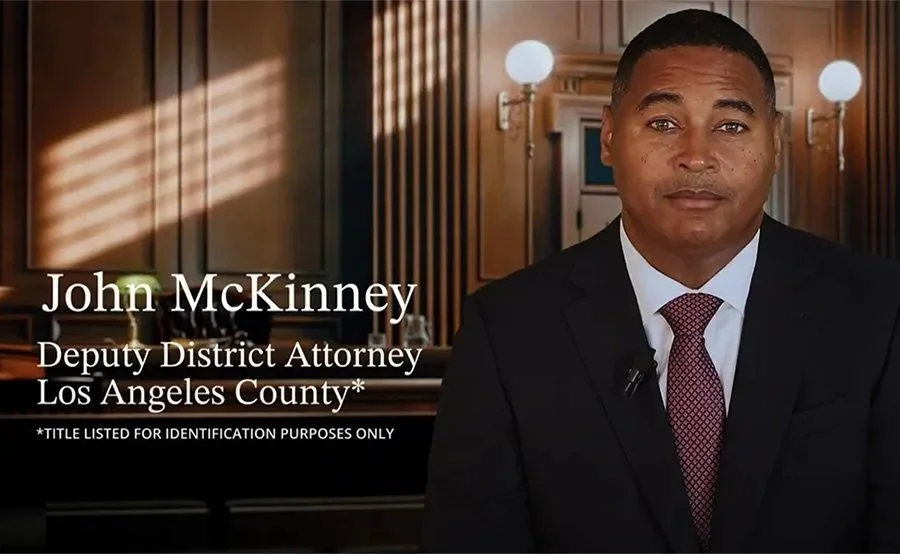
Deputy District Attorney for Los Angeles County John McKinney profile photo. Sourced from Nathan Hochman’s 2024 political campaign for Los Angeles District Attorney.
INTRODUCTION
What follows is a consolidated misconduct profile of a Los Angeles County government Deputy Prosecutor named John Edward McKinney, whose decisions repeatedly departed from constitutional obligations and fundamental prosecutorial ethics. Each incident documented herein is supported by records, court filings, correspondence, or sworn testimony.
Individually, any one of these incidents might be dismissed as a discretionary judgment call. Taken together, they reveal something far more serious: a sustained and deliberate abuse of power used to shield favored political interests, silence whistleblowers, and use victims as mere props for the purposes of masquerading around to create an illusion of caring about protecting and serving We The People. This profile makes it clear that McKinney’s ultimate end goal and interest is gaining political power for himself and his co-conspirators, regardless of the harm done to others.
This profile is a living record. As additional documents are obtained, corroborated, and verified, they will be appended to this same profile so that the public, journalists, attorneys, and oversight bodies may evaluate the full scope of conduct in a single, continuously updated repository
MISCONDUCT - QUID PRO QUO FOR POLITICAL FAVORS
On June 30, 2026, a formal ethics complaint was filed with the Los Angeles Ethics Commission against Deputy District Attorney John Edward McKinney (State Bar #194455) — the sitting Director of the Bureau of Specialized Prosecutions at the L.A. County District Attorney's Office and a declared candidate for Los Angeles City Attorney in the 2026 election. The complaint accuses McKinney of using his position and public government resources a government employee at the District Attorney’s Office for political and campaign activity continuously from December 2020 to the present — approximately five and a half years. It also names four others whose conduct it says enabled or participated in that activity: District Attorney Nathan J. Hochman, Chief Deputy District Attorney Steven I. Katz, Communications Director Josh Rubenstein of the District Attorney’s Office, and press contact Mike Marando.
Specifically, the complaint alleges:
The use of county facilities for political speech — beginning with a December 31, 2020 speech McKinney delivered at the Hall of Justice attacking his own elected boss, former District Attorney George Gascon.
The use of county-compensated time, equipment, and McKinney's official title across three consecutive political campaigns: the 2021–22 Gascón recall, his own 2024 run for District Attorney, and his current 2026 run for City Attorney.
A county-funded podcast, produced by the Los Angeles Office of the District Attorney's own Communications Director Josh Rubenstein, that functioned as campaign content for McKinney — and was converted into actual campaign content by McKinney.
A pattern of non-compliance with the DA Office's own Legal Policies Manual, including its candidacy-disclosure and content-approval rules.
Shared press and campaign personnel between the public DA's Office and McKinney's private campaign committee.
A series of personnel actions that, taken together, describe a quid pro quo: McKinney endorsed Hochman for office; after Hochman won, McKinney was promoted into one of the most powerful jobs in the office as a direct result of McKinney’s political devotion.
Nearly every factual building block beneath these statements comes from the public record: court filings, FPPC disclosures, L.A. Times reporting, DA Office press releases, and McKinney's own campaign materials. To evaluate the accusations, you need to understand two bodies of rules — the DA Office's internal policies, and California's public-resource and campaign laws.
Documents:
The Los Angeles District Attorney’s Office Rulebook and Policies
The Los Angeles County District Attorney's Office maintains a document called the Legal Policies Manual (LPM) — the internal law of the office, binding on every deputy DA. Three provisions matter here.
LPM § 26.09.04 — Tell the Chief Deputy Before You Run
A deputy DA who is "considering seeking another public position" must "promptly inform the Chief Deputy by memorandum." Note the trigger: considering, not announcing. The moment a deputy starts weighing a candidacy, the obligation attaches. The rule exists so the office can manage conflicts before they happen — reassign sensitive cases, wall off resources, and protect the office's neutrality.
LPM § 26.10.01 — Content Made on County Time Gets Approved First
Media content produced during office hours requires prior written approval from the Chief Deputy, and the Chief Deputy must review the final product. Podcasts, videos, publications — anything a county employee creates on county time is county speech, and someone accountable must sign off on it.
LPM § 2.01.02 — No Official Action on an Improper Basis
The broadest rule of all: official action — including personnel action — may not be taken on an improper basis, and the office must avoid even the appearance of impropriety. A promotion handed out as a political reward isn't just unseemly under this rule. It's entirely prohibited.
Documents:
The Law: What California Actually Prohibits
Government Code § 8314 — The Public-Resources Ban
California Government Code § 8314(a) makes it unlawful for any elected official, appointee, or employee — state or local — to use public resources, or permit others to use them, "for a campaign activity, or personal or other purposes which are not authorized by law."
Section 8314(b)(3) defines "public resources" expansively: land, buildings, facilities, funds, equipment, supplies, telephones, computers, vehicles, travel — and state-compensated time. If the taxpayer is paying for it, it cannot be used to advance a campaign. A speech in a county courthouse. An email from a county account coordinating a media hit. A press release drafted at a county desk. A staffer's paid hour spent on campaign work. Each one is a violation.
The penalties are severe by design: § 8314(c)(1) imposes civil liability of up to $1,000 for each day a violation occurs, plus three times the value of the public resources unlawfully used. The conduct alleged in the McKinney complaint spans roughly 2,000 days.
Documents:
The Political Reform Act and the FPPC
Layered on top of § 8314 is the Political Reform Act of 1974, enforced by the California State Fair Political Practices Commission (FPPC). The Act requires committees — like McKinney's "John McKinney for City Attorney 2026," FPPC ID #1487830 — to disclose contributions and expenditures, and it prohibits coordination between a candidate and "independent" expenditure committees. An IE that is actually coordinated with the candidate becomes an illegal, unreported contribution. Keep that rule in mind when you get to the numbers below: as of April 18, 2026, McKinney had $73,000 in direct contributions and $789,000 in independent expenditures on his behalf — more than ten dollars of outside money for every dollar he raised himself.
The Los Angeles City Ethics Commission
Because McKinney is running for a City of Los Angeles office, the L.A. City Ethics Commission — which administers the city's campaign finance and governmental ethics laws — is where the complaint was filed. The Commission can investigate, subpoena records, hold hearings, impose administrative penalties, and refer matters to criminal prosecutors. One historical footnote worth savoring: from 2011 to 2016, the president of the Ethics Commission was Nathan Hochman. He was appointed by former City Attorney Carmen Trutanich in July 2011. The Los Angeles City Council unanimously confirmed his appointment. Nathan Hochman served alongside Jessica Levinson, Erin K. Pak, Ralph David Fertig, Melinda Murray, Lee Kaplan, Richard Drooyan, and Jill Banks Barad.
The Backdrop: Gascón, Hochman, and an Office at War With itself
None of this happened in a vacuum. In December 2020, George Gascón took office as District Attorney and immediately issued sweeping directives — no death penalty, no sentencing enhancements in most cases, restrictions on juvenile transfers — that ignited open rebellion inside his own office. His deputies' union, the Association of Deputy District Attorneys (ADDA), sued him within his first month. Many of the ADDA members voted to support recalling him. You can read many of the official court filings for free below at the official ADDA website and Case Number 20STCP04250.
Documents:
Nathan Hochman arrived as the vehicle for that rebellion. A former federal prosecutor, Assistant U.S. Attorney General, 2022 Republican nominee for state Attorney General, and — as noted — former president of the L.A. City Ethics Commission, Hochman ran in 2024 as an independent promising to restore integrity and professionalism. He collected the ADDA's endorsement, and on November 5, 2024, he beat Gascón by roughly twenty points. He was sworn in on December 3, 2024.
The story of John McKinney's political career runs exactly parallel to this war — and, at every key juncture, through county property. Interestingly and oddly paradoxically, at the time of this article’s publication, the same ADDA that once supported Nathan Hochman has now come full circle to turn against Hochman, citing countless times of willful neglect and bad-faith dealing by Hochman, as well as Hochman failing to live up to his political campaign promises to the labor union. You can read the full story below originally published by Westside Current on June 19, 2026.
Documents:
John McKinney’s Rise to Political Fame - Step by Step
McKinney joined the DA's Office around 1998 and built a genuinely distinguished record as a homicide and gang prosecutor, including the first-degree murder conviction of Nipsey Hussle's killer. He served under five district attorneys. His political career, per the ethics complaint, began 28 days into the fifth.
December 31, 2020 — The Hall of Justice Speech
McKinney, a sitting deputy DA, delivered a public speech at the Clara Shortridge Foltz Criminal Justice Center attacking Gascón and his policies. The Hall of Justice is a county facility; § 8314(b)(3) covers buildings and facilities by name. Was McKinney off duty? Was a facility permit obtained, and by whom? Was county equipment used? Was Sheriff's Department security coordinated? No public record answers any of it, and McKinney has produced none. His campaign materials later cited the speech as the founding moment of his political leadership — meaning his own campaign treats an event on county property as campaign asset number one.
2021–2022 — The Face of the Recall
For roughly eighteen months McKinney was the most visible advocate for recalling Gascón — publicly described as "the face of the attempted recall." He appeared on Fox News, Fox 11, and KFI identifying himself as a deputy district attorney. Every booking obtained on the strength of that county title, every appearance on county time, every county device used to coordinate with a producer is a potential § 8314 violation. On July 6, 2022, he said on camera that if the recall succeeded, he would run for DA. That statement triggered LPM § 26.09.04 — "considering seeking another public position" — and no public record shows he ever filed the required memorandum.
2023–2024 — The DA Campaign, the Loss, and the Pivot
McKinney announced his DA candidacy in March 2023 and ran through the March 2024 primary while serving full-time as Deputy-in-Charge of the East L.A. branch office. He lost. Then came the pivot that defines everything after: on April 8, 2024, McKinney and fellow deputy Maria Ramirez endorsed Hochman at a Compton press conference — Hochman's campaign framed them as standing "against their boss, George Gascón" — and McKinney spent the next seven months as a Hochman surrogate. The L.A. Times credited him with having "helped boost his campaign against Gascón."
November 2024 — The Payoff
Hochman won on November 5. The Times reported McKinney "was promoted to oversee all special prosecutions in the office after Hochman's election night victory" — installed as Director of the Bureau of Specialized Prosecutions, commanding the office's most serious cases: Major Crimes, Hardcore Gang, Sex Crimes, Family Violence, and more. The seat he took belonged to Maria Ramirez — the other endorser on the Compton stage — who was herself moved up to Assistant DA.
No public record shows the Director position was posted. No public record shows a competitive process. No public record shows any other candidate was considered. Both deputies who publicly endorsed the winning candidate were promoted by him. Under LPM § 2.01.02, which bans official action on an improper basis or even its appearance, the question answers itself: whatever this was, it at minimum looks exactly like what it looks like.
Documents:
The 2026 McKinney Political Campaign and the Machinery Behind It
The Podcast Testimonial Using the District Attorney’s Office
On January 15, 2026, the DA's Office released an episode of its podcast, "The Hard Middle," produced by Communications Director Josh Rubenstein, featuring Hochman, McKinney, and prosecutor Cindy Wallace discussing the Michelle Avan murder case. At the 19:06 mark, Rubenstein — a county employee, on county time, on a county-funded platform — told listeners McKinney is "incredibly successful," "respected in this office," and "one of the smartest people I know here." Those are not job descriptions. They are character testimonials, the kind campaigns pay consultants to engineer.
The next day, McKinney cross-posted the episode to his personal @johnmckinney_ Instagram — the same account that now carries his City Attorney campaign — highlighting his Director title and urging followers to listen. A county communications product became campaign content in under twenty-four hours. Whether Chief Deputy Katz gave the prior written approval and final review that LPM § 26.10.01 requires is unknown; no approval record has been produced.
Documents:
PDF copy of Instagram post on John McKinney’s political campaign account of the podcast testimonial
Transcript of podcast episode with Josh Rubenstein and John McKinney
Campaign Quickly Born and Fully Grown
On March 24, 2026, McKinney announced for City Attorney. Operational on day one: the McKinney4LA.com website, a produced 60-second launch video, FPPC committee #1487830, endorsements from former DAs Steve Cooley and Jackie Lacey, and a retained press contact, Mike Marando. Infrastructure like that takes months. The § 26.09.04 duty attached months earlier — while McKinney sat in his Director's chair drawing a Director's salary. Again: no memorandum on record.
The Endorsement and the Shared Press Contact
On May 5, 2026, Hochman and the L.A. Police Protective League jointly endorsed McKinney — a move the Times itself flagged as unusual, since DAs almost never intervene in City Attorney races (Gascón endorsed no one in 2022). Now the detail that turns an endorsement into evidence: the press contact on the endorsement release is Mike Marando, (916) 225-2780. The press contact on McKinney's own campaign releases, including his launch announcement, is Mike Marando, (916) 225-2780. One man, one phone number, speaking simultaneously for the District Attorney's public communications and the private campaign the District Attorney endorsed.
Widen the lens and the overlap is total: McKinney's 2026 campaign is run by Hochman's 2024 campaign manager and funded through Hochman's 2024 fundraiser, Trey Kozacik of the Pluvious Group — who also ran McKinney's own 2024 fundraising. If any of these shared operatives touched county systems, county email, or county-compensated time, each instance is a separate § 8314 violation. And the ten-to-one ratio of independent expenditures to direct contributions makes the Political Reform Act's coordination ban anything but academic.
Documents:
The Josh Rubenstein Racism Problem
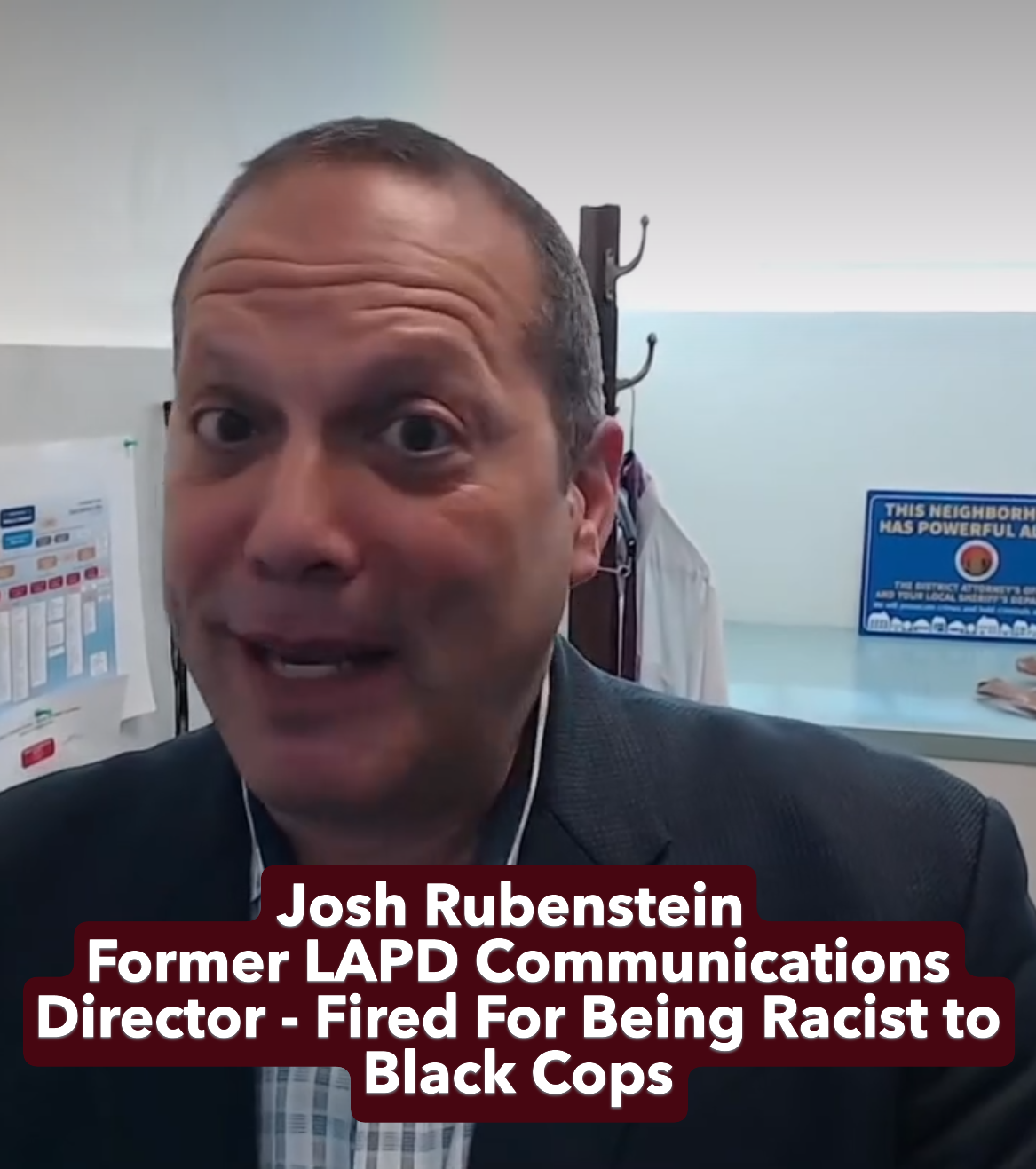
Photo of Josh Rubenstein.
He previously worked as the Communications Director for LAPD for approximately 5 years. He was eventually fired due to incessantly making racist slurs to black cops in the agency. His racism is undisputed and seen in the LAPD whistleblower lawsuit of Officer Raymond Brown, who was one of Rubenstein’s victims.
The man who delivered the podcast testimonial deserves his own chapter, because his history goes to what this DA administration was willing to overlook in staffing its public voice.
Josh Rubenstein was a CBS Los Angeles weathercaster until 2016, when he became the LAPD's civilian Communications Director, running the Media Relations Division until 2021, followed by a stint at Kaiser Permanente. In late 2024 or early 2025 — the DA Office's April 2025 organization chart confirms it — the Hochman administration installed him as the county DA's Communications Director, reporting directly to Hochman.
What sat in the public record when they hired him: Raymond Brown v. City of Los Angeles, L.A. Superior Court Case No. 20STCV19714. Brown, a Black LAPD officer in Rubenstein's own division, sued the city in May 2020 for retaliation under the Fair Employment and Housing Act and whistleblower retaliation under Labor Code § 1102.5. In the court's January 2024 ruling denying the City's motion for summary judgment, the core conduct was listed as undisputed: in late 2017, Rubenstein repeatedly greeted Brown and fellow Black officer Lyle Knight with "how are you boys?"; the officers asked him to stop, citing the term's history as a racial degradation of Black men; he did it again — a fourth time loudly enough that a captain overheard it and personally apologized to the officers.
Brown alleged that after complaining he was passed over for promotion three times in favor of less qualified candidates, and that management held against him the expectation that he would testify for Sgt. Frank Preciado — a supervisor separately suing the city over orders, attributed to Rubenstein and Capt. Patricia Sandoval, banning Spanish in the division. Preciado's suit settled in 2022.
The City fought Brown for over four years and lost every consequential motion: its attempt to enforce a disputed $50,000 settlement (denied, 2022), its motion for summary judgment (denied, January 2024), even its motion in limine to keep the word "boys" out of the trial (denied). On September 3, 2024 — the morning trial was to begin — the City settled. Terms undisclosed. No admission of liability. Weeks later, the incoming Hochman administration handed Rubenstein the county's microphone. Whether anyone in an office made up entirely of litigators reviewed the publicly reported settlement before the hire is unknown — and is among the pending records requests. It is also this Communications Director whose county-funded podcast delivered the McKinney testimonial.
The Union That Elected Nathan Hochman Now Hates Him
Hochman's 2024 victory was powered by the ADDA — the union representing over 800 deputy DAs, which endorsed him many of its members had voted to recall Gascón. The union believed it was electing a partner. On June 18, 2026, that same union filed an Unfair Labor Practice Charge with the L.A. County Employee Relations Commission against both the County and the DA's Office, alleging repeated failures to bargain in good faith across more than a year of failed contract negotiations.
The same ADDA that once supported Nathan Hochman has now come full circle to turn against Hochman, citing countless times of willful neglect and bad-faith dealing by Hochman, as well as Hochman failing to live up to his political campaign promises to the labor union. You can read the full story below originally published by Westside Current on June 19, 2026.
Documents:
The dispute isn't even about money. Per the union, it's about whether agreements reached in Joint Labor Management Committee meetings should be put in writing — a bare-minimum transparency measure the County and the Office have refused, along with proposals merely referencing the Meyers-Milias-Brown Act, the state law governing public-employee bargaining. ADDA President Ryan Erlich put it directly: "District Attorney Nathan Hochman campaigned on restoring trust and integrity within this Office. That commitment should begin with honoring the law at the bargaining table." The office disputes the charge and says it has bargained constructively. But mark the pattern: the administration that found time and resources to podcast its favored candidate into a City Attorney race could not, in over a year, agree to write down what it agreed to with its own prosecutors.
Nathan Hochman Also Worked As Former Sheriff Lee Baca’s Lead Defense Lawyer
One more piece of history completes the picture of who is running this office. Before he was District Attorney, Nathan Hochman was the lead defense attorney for former L.A. County Sheriff Lee Baca — the man convicted of obstruction of justice, conspiracy, and lying to the FBI for orchestrating a scheme to hide an informant from federal agents investigating brutality and corruption inside the county jails. Ten members of the Sheriff's Department were convicted in that scandal; prosecutors described Baca as the top figure in the conspiracy.
Hochman tried the case twice — winning an 11–1 hung jury the first time — and after Baca's 2017 conviction, argued that the sheriff who obstructed a federal civil-rights investigation should serve no prison time at all, only home detention and community service. The judge sentenced Baca to three years, telling him his actions "embarrassed the thousands of men and women who put their lives on the line every day."
Everyone is entitled to a vigorous defense, and defending Baca was legal, ethical, and professionally unremarkable. But voters assessing this administration's instincts on institutional accountability are entitled to weigh the full résumé: the current District Attorney of Los Angeles County built part of his career arguing that the most corrupt sheriff in modern county history deserved zero days in prison. That is the sensibility now deciding which records requests get answered, which staff conduct gets reviewed, and which political favors get called what. You can read the complete criminal prosecution of former Sheriff Lee Baca and former Undersheriff Paul Tanaka below for free on CourtListener.
Documents:
The Records, The Stonewalling, and What Must Happen Now
Nearly every open question in this story has a documentary answer sitting in the DA Office's files: the Hall of Justice facility records and McKinney's duty status for December 31, 2020; any § 26.09.04 memoranda from 2022, 2023, or 2025–26; the requisition, posting, and selection file (if any exists) for the Director of Specialized Prosecutions position; Rubenstein's hiring and background-review file; the § 26.10.01 approval records for The Hard Middle; and all communications between Hochman, Katz, McKinney, Rubenstein, and Marando touching the endorsement and the campaign.
Public records requests seeking these documents are pending with the DA's Office. Under the California Public Records Act (Gov. Code § 7920 et seq.), an agency must make a determination on a request within ten days, extendable once by fourteen days in unusual circumstances, with written notice. According to the requester, the DA's Office has let its statutory response window lapse without issuing the required determination. A prosecutorial agency — the entity that charges other people with breaking the law — blowing a legal deadline on requests about its own conduct is not a clerical footnote. It is the thesis of this story restated in miniature, and it is a preview of the transparency Angelenos should expect from a City Attorney's Office staffed, funded, and endorsed by the same circle.
What the Enforcement Bodies Can and Should Do
The L.A. City Ethics Commission should open a formal investigation, use its subpoena power to obtain the records the DA's Office is withholding, and adjudicate the complaint on the documents rather than the denials. Where its city-law jurisdiction ends, it should refer.
The FPPC should examine the coordination question head-on: a 10:1 ratio of independent expenditures to direct contributions, layered over a campaign that shares its manager, fundraiser, and press contact with the sitting DA's operation, is precisely the fact pattern the Political Reform Act's coordination rules exist for.
Civil enforcement under § 8314 lies with prosecuting authorities — and therein sits the structural problem: the agency with the most natural jurisdiction is the one implicated. That is what the Attorney General's office is for. With exposure of up to $1,000 per day across roughly 2,000 days, plus treble the value of resources used, this is not a parking ticket.
The courts remain open on the records: CPRA non-compliance is independently enforceable by petition, with mandatory attorney's fees for a prevailing requester.
Conclusion
The voters of Los Angeles are being asked to hand John McKinney the office that decides who gets prosecuted in this city — with the endorsement of a District Attorney whose office promoted him after he endorsed it, podcast him before he announced, shares his press contact, stonewalls the records, faces an unfair-labor-practice charge from its own prosecutors, and is led by Lee Baca's former defense lawyer. Before Angelenos vote, they are entitled to the answers this office is sitting on.
The complete document repository — the ethics complaint, the Brown v. City of Los Angeles filings, court minute orders, FPPC records, and every source cited above — is maintained and continuously updated at AuditTheGovernment.org, with the underlying court records mirrored on DocumentCloud. Subscribe to follow the records fight as it unfolds.
Note: The ethics complaint and the ADDA unfair labor practice charge contain allegations that are pending and have not been adjudicated; the DA's Office disputes the ADDA's characterizations. Brown v. City of Los Angeles settled without any admission of liability, and Josh Rubenstein was not a named defendant in it. No court or commission has found any individual named in this article to have violated any law or policy. Conclusions drawn from the public record are the opinion of the author; readers are encouraged to review the primary documents and judge for themselves.
UPDATE AS OF AUGUST 12, 2026
Los Angeles City Ethics Commission Corruption and Refusal to Investigate John McKinney
On June 30, 2026, a formal complaint was filed with the Los Angeles City Ethics Commission against John McKinney for his violations outlined in this article.
On July 9, 2026, the Los Angeles City Ethics Commission replied to this complaint, stating that they will not be investigating John McKinney for his misconduct of abusing his County government position for the purposes of furthering his political campaign run as a candidate for the City Attorney of Los Angeles.
The statements made by the Los Angeles City Ethics Commission are definitively false and I will demonstrate why their statements were also made with intentional negligence and malice. The two images below show screenshots of the legal responsibilities and mission statement taken directly from the official public website of the Los Angeles Ethics Commission. These images show that the Los Angeles City Ethics Commission is directly responsible for investigating Los Angeles City election political campaign rules, regardless of what job title the individual being investigated holds, so long as that person is politically campaigning for public office in the city of Los Angeles.
To state the obvious, the Office of the Los Angeles City Attorney is indeed a public office in the city of Los Angeles whereby a new City Attorney is publicly democratically elected every 4 years. John McKinney is currently running as a candidate for the Los Angeles City Attorney. You can view the official website of the Los Angeles City Ethics Commission by clicking here. You can also easily find their website online by typing ethics.lacity.gov.
In summary - Los Angeles County government employees who run for public office in the City of Los Angeles are NOT exempt from auditing, investigation, or prosecution by the Los Angeles City Ethics Commission. However, the reply and disposition by the Ethics Commission says this is the reason they are not prosecuting John McKinney.
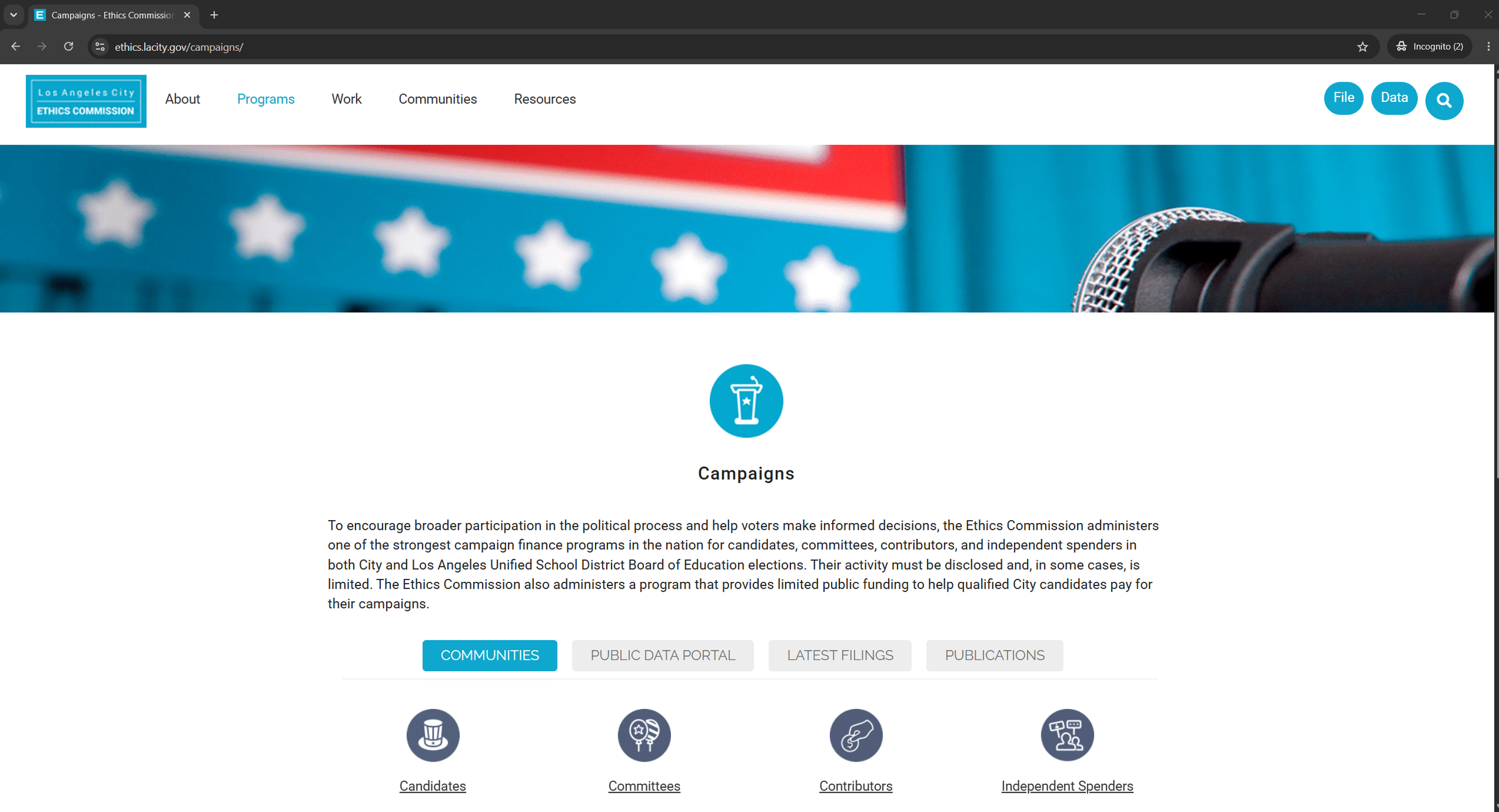
Screenshot of Los Angeles City Ethics Commission website - Political Campaign Duties of the Commission
Dated August 12, 2026, this screenshot shows the legal duties and responsibilities of the Los Angeles City Ethics Commission as it relates to political campaigns of candidates running for public office within the City of Los Angeles.
One example of these publicly democratically elected positions includes the Los Angeles City Attorney, which John McKinney is running for in 2026.
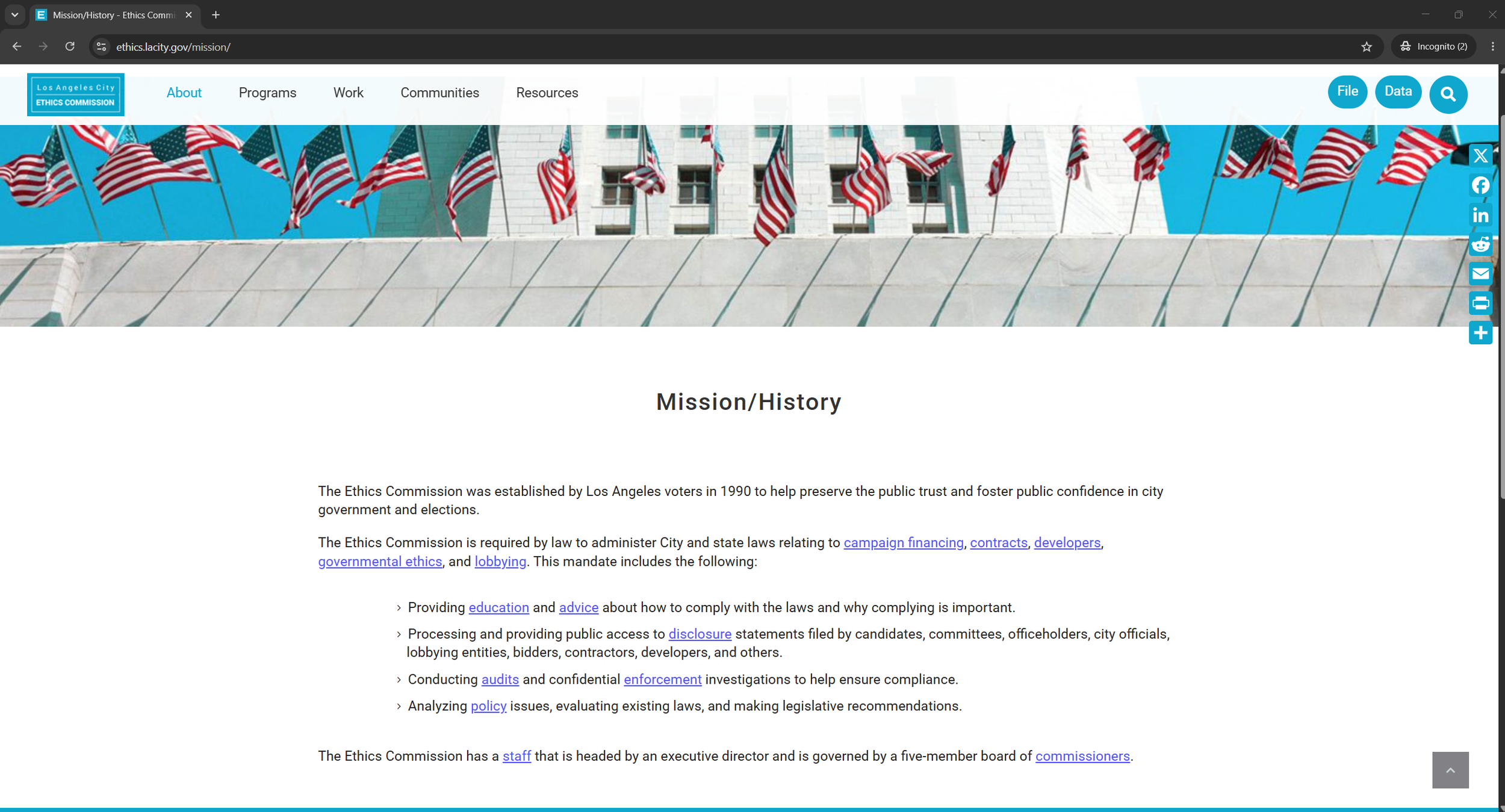
Screenshot of Los Angeles City Ethics Commission website - Mission Statement
Dated August 12, 2026, this screenshot shows the mission statement of the Los Angeles City Ethics Commission, which explicitly states that it conducts audits and investigations to ensure enforcement of compliance.